Showing posts with label France. Show all posts

Saturday, 23 March 2019

Turning enmity into an unmatched friendship: France and Germany

Today marks 56 years since the signing of the Élysée Treaty between France and Germany. The ambassadors of two countries talk to the Cyprus Mail about what it meant for Europe

By Esra Aygin

“MY HEART is overflowing, and my soul is grateful,” said French President Charles de Gaulle in fluent German after he and German Chancellor Konrad Adenauer signed the Élysée Treaty exactly 56 years ago today.

The revolutionary document of 22 January 1963 marked the beginning of peace and reconciliation between hereditary enemies France and Germany. It also changed the future of Europe, by laying the foundations of the European Union.


“We were able to overcome the pain of the past by looking at the future,” say René Troccaz, the Ambassador of France and Franz Josef Kremp, the Ambassador of the Federal Republic of Germany to Cyprus in a joint interview to mark the anniversary of the signing of the Élysée Treaty,

Almost every family both in France and Germany has lost at least one member to the centuries-old bloodshed between the two countries. How is it then, with so much pain and sorrow on both sides, that the two countries have been so successful in turning enmity into friendship and cooperation, and build a joint future?

Ambassadors Troccaz and Kremp explain that it was a process that required not only leadership but also a strong sense of ownership and involvement by the societies.

“The will of leaders was of course important,” says Ambassador Troccaz of France. “Complementary to that, both leaders were able to address their public. They explained saying ‘we need to jump this step and to reconcile. There is no way we can keep on the memories the remembrances of the war.’”

Of course, as every reconciliation process, the reconciliation between France and Germany took time.

“It was a process that started with the Élysée Treaty but it’s a long lasting process over many decades that involves the whole society,” explains Ambassador Kremp. “The pain has to heal and you have to grow closer to each other. And the idea of the Élysée was to bring people together, to overcome stereotypes and prejudice and to see the real person on the other side.”

With the Élysée Treaty, France and Germany committed themselves to discussing all important policy matters, including those related to foreign affairs and defense, and pledged to “arriving insofar as possible at a similar position” on all the important economic, political and cultural issues.

There was a special focus on youth and education, as de Gaulle and Adenauer knew very well that it is not possible to change the future without changing the way the youth are brought up.

“It’s a question of in what spirit you educate young people,” remarks Ambassador Kremp. “It takes a different approach, a different spirit to create change. This is why there was a focus on youth.”

There was a need to create joint policies, practices and messages to the youth, Ambassador Troccaz adds. “France and Germany tried to address very concretely, how to encourage learning the language of the other country. They organized youth exchange programs, cultural encounters, school twinnings and joint university programmes. A Franco – German university was established. We have dozens of fields of cooperation addressing the youth. I will dare to say it’s a system. It’s an organized system.”

The Franco-German Youth Office was one of the first things that were established after the signing of the Élysée Treaty. To this day, it has enabled millions of young German and French to meet and take part in exchange programs.

Since the signing of the Élysée Treaty, tens of joint commissions of experts have looked at all the school material in an effort to find common ground on how to present the past, approach it in a way that is constructive for the future and to overcome the prejudices.

The world’s first joint history book co-written by French and German historians was published in both languages in 2006 and is used in high school history classes.

Cooperation between the two countries has not been limited to youth and education. It has developed into a natural thing that currently covers all segments of society and life. France and Germany have a common defence and security council, a financial and economic council, and councils devoted to culture and environment. There is a Franco-German Brigade, a joint army corps, joint sports clubs, exchange programs between French and German diplomats at both countries’ foreign ministries, a joint television channel – ARTE, and more than 2,000 twinnings between German and French towns and cities.

France and Germany have also changed the way they commemorate the past. Instead of focusing on who was victorious and who was defeated in past wars, they commemorate both the French and German victims through joint gestures and joint monuments.

On 11 November 2018, to mark the anniversary of the World War I Armistice for example, French President Emmanuel Macron and German Chancellor Angela Merkel jointly visited the site where Germany signed the armistice in 1918, and then Hitler, in an act of revenge, forced France to accept defeat in 1940. As the French and German national anthems played, the two leaders laid a wreath and unveiled a plaque celebrating the reconciliation between their countries.

“You realise there was so much pain and sorrow on both sides that there is no room for triumph, says Ambassador Kremp, whose grandfather fought the French in the First World War and father in the Second World War. “You commemorate the victims – and not only soldiers, also civilians – on all sides.”

All these efforts have contributed to overcoming the hostility and reversing the public opinion in both countries. Opinion polls demonstrate that the French and the Germans, who viewed each other as the ‘enemy’ until 1960s, now regard each other as each others’ number one ally. And the two countries that have turned enmity into an unmatched friendship, now feel the shared responsibility to strengthen the European Union.

“It’s the whole. It’s the education, it’s the perspective and it’s the fact that people realise that in the world we are living in today, our future is European and our partner is Germany,” says Ambassador Troccaz. “When it all started in the 1960s, the subject was reconciliation and peace. Now the subject is Europe. It’s not only that we are neighbours and good friends. It’s that we have a project. That we built something together.”

“Now our focus is Europe,” agrees German Ambassador Kremp. “It is to help form Europe into something that can play a role in world stage on equal footing with other world powers.”

Fifty-six years on since the signing of the Élysée Treaty, today, Macron and Merkel will be signing the Treaty of Aachen to renew their commitment to each other and to pool their strengths for a strong and sovereign Europe that will safeguard the future for millions of Europeans.


“No progress is complete,” underlines Ambassador Kremp. “With every achievement, you have to fight to preserve it for the next generations. Many things are taken for granted today. My niece and nephew cross the border between Germany and France without showing a passport. They cannot imagine that what they have can be threatened and questioned again. We have to make sure achievements we make are passed to the next generation.”

Wednesday, 19 December 2018

If France and Germany can reconcile, why can’t we?

By Esra Aygin

The way countries look at their past say a lot about how they envision their future.

Coming from a country where to view the past means selective and dishonest remembering, half-truths and lack of self-criticism are the norm, seeing the way France and Germany handle theirs is both amazing and enviable.

I was in Paris for the Peace Forum on Armistice Day last month. The events organised for the anniversary of the World War I armistice, not only marked 100 years since the end of the war, but brought forward powerful acts of reconciliation between France and Germany.

The two countries, which fought each other mercilessly in not only one, but two world wars, have been able to leave behind their bloody past and build a joint future.

On this year’s Armistice Day, French President Emmanuel Macron and German Chancellor Angela Merkel jointly visited the site where Germany signed the armistice in 1918, and then Hitler, in an act of revenge, forced France to accept defeat in 1940. It was the first time since 1940 that leaders from France and Germany had met at this historic site. As the French and German national anthems played, the two leaders laid a wreath and unveiled a plaque celebrating the reconciliation between their countries.

Millions of deaths, years of bloodshed, indescribable suffering … yet Macron and Merkel were now hand in hand, commemorating both the French and German victims, condemning nationalism and praising unity.

Their every act, every sentence, every message were lessons in reconciliation, forgiveness and vision.

“I’ve seen where, jumbled together in mass graves, lie the bones of German and French soldiers who, one freezing winter, killed one another for a few metres of ground,” said Macron during his speech. “The lesson of the Great War cannot be that of resentment by one people against others… It’s a rootedness that forces us to think about the future and what is essential.”

On the same day, at the opening of the Paris Peace Forum, Merkel said the two world wars were “examples of the disastrous consequences a lack of compromise in politics and diplomacy can have”.

“It’s anything but self-evident” that Germany and France should have such friendship now, “especially after the suffering that Germans caused to their neighbour, to Europe and the world in two world wars,” she added.

There were no triumphant statements, no valour, no display of military might during the Armistice Day events. No fighter jets circling the skies, no glorification of war and killing, no nationalist slogans. There was no distinction between the victorious and defeated, but a lot of looking at the past, reflecting, reconciling, and moving on with a strong commitment to peace. And a deep respect – regardless of their nationality – for the people, who lost their lives in past wars.

Watching them, I couldn’t help but think: When will we, in Cyprus, ever be able to commemorate all the Turkish Cypriot, Greek Cypriot, Armenian, Maronite, Latin victims of our war? When will we ever be able to feel the same pain for each and every one who lost their lives, got wounded, displaced and suffered, regardless of their ethnic background? When will we finally see the human behind the ethnicity that has blinded us? When will we ever be able to look at the past and see our own mistakes too? When will we ever be able to remember all – not half of our history – and articulate what the past should mean for the future? When will we finally reconcile with our past and start looking forward? Say ‘never again’, instead of ‘I won’t forget.’ And when will we ever be able to condemn nationalism?

“Patriotism is the exact opposite of nationalism: nationalism is a betrayal of patriotism,” Macron said in his speech on Armistice Day. “In saying ‘our interests first, and who cares about the rest’ you wipe out what’s most valuable about a nation: its moral values.”

Macron was talking about the same nationalism that we, in this country, take pride in, glorify and celebrate! The same nationalism that made brothers turn against each other and tore this country apart? The same nationalism that created Eoka B and TMT; that invited the coup d’etat and the invasion. The same nationalism that we systematically poison our school children with. The same nationalism that makes us hate people we don’t even know.

He was talking about the same nationalism that wants to close the crossing points and attacks Turkish Cypriot cars. The same nationalism that legitimises usurping other people’s properties and draw huge flags on mountains. The same nationalism that makes us believe to our cores that it is okay to close off entire towns and deny people their streets, memories, cemeteries.  The same nationalism that has taken away our sense of shame.

The same nationalism that makes us believe that only our suffering, pain and fear is legitimate. The same nationalism that has convinced us that the “other” is insignificant.

Macron was talking about the same nationalism that makes us want to fight rather than compromise, prefer the dangerous unknown to reconciliation, go for permanent partition rather than a united Cyprus.

He was talking about the same nationalism that we have praised or at least tolerated to the point of legitimising and mainstreaming the far-right, fascist ideologies in this country.  The far-right and fascist ideologies that have brought nothing but hell to the places they nestled.


When will we ever learn?

Tuesday, 26 May 2015

Interview with Ambassador Jean Luc Florent of France in Nicosia (25 May 2015)


How do you read the Turkish Cypriot election results?
Florent: My understanding is that there are three main messages. First one is a call for a political change at the level of leader, and I think that the result obtained both by Mr. Akinci and also by Mr. Ozersay is indicating that there was need for a change. The second message is, of course, the willingness to reach a settlement in the Cyprus issue. And the third one, is, having - according to what Akinci said during the campaign and immediately after his election  - a more-balanced relationship between Turkish Cypriots and Turkey. These are in my view, the three main messages.

Were you expecting such an overwhelming support for Mr. Akinci?
Florent: We received information some days before that maybe Mr. Akinci would win the election. So we were not totally surprised. But it is true that the score, which was obtained by Mr. Akinci, was in a way surprising. But we were not surprised by his election as such.

Do you read this as the Turkish Cypriots challenging the status quo and putting forward a very determined desire for change for the second time?
Florent: Well, yes, this is my reading of the elections. So I think there is a real willingness for a change.

Now there is a new process. Why should this process be any different than the previous ones that all failed?
Florent: First of all, I think there is real mutual confidence and trust between the two leaders – Mr. Akinci on one side, and Mr. Anastasiades on the other side. And having discussed with Mr. Anastasiades recently last week, I can tell you that he gave me the impression that there was a real confidence and trust between the two. So I think this is a very important aspect. Trust. I think this is also amplified by the fact that they are sharing the same vision. And this is important. So there is trust on the one side, and the fact that they are sharing the same vision as far the settlement of the Cyprus problem is concerned. Mr. Akinci made very clear statements that the goal of a settlement is a real federation, but not something that looks like a confederation. And this is an aspect, which is very important, because the predecessor of Mr. Akinci was not always clear when he was mentioning what a settlement would be.

What do you think of the first CBMs that the two leaders announced?
Florent: First of all, they are encouraging. Secondly, they are useful. The important thing is to concentrate on small confidence building measures, which have a real, direct and quick impact as far the population is concerned. This is very important because it will introduce trust between the two communities. And it will facilitate the daily life, being the crossing aspects, being the possibility for interconnection as far mobile phones are concerned. The CBMs will help contact between the two communities and the mobility between the two communities. And of course it will be useful for the settlement. So we are very encouraged and my understanding is that during the next meeting of the leaders, which is scheduled for the 28 of May, I think more CBMs will be proposed. As I said they are very important because they are the direct impact on the population.

Varosha seems to raise caution in UN and other actors as CBM because it risks diverting attention and resources from comprehensive solution. What is your stance?
Florent: I think the question of Varosha is both complex and symbolic. So I think it is important to try to find something about Varosha, but in a way, which will not interfere with the substantive negotiations. And this is why I think - and this is the understanding of the two leaders at least from the impression I get- it is important to have a parallel process and to give time in order to see if there is a possibility to reach something about Varosha. But it will be at a later stage and as I said, in parallel with the negotiations process in order to avoid interferences between the two. I think it is important for the confidence in general for both communities and for trust and confidence in the negotiation process that if there are progresses in CBMs such as the one on Varosha. I think it is important to keep them in mind but there is no necessity to rush. And it must not be a precondition. And it is my understanding that now it’s clear that it is not a precondition. As I said it will be in parallel with the negotiation process. So, it is true that something on the CBM, which is highly political like this one, will help and facilitate the process, but there should be no rush.

The priority should be comprehensive solution?
Florent: It is the priority and it is the objective of the two leaders. This is my understanding. Now, they are on the same line that they will discuss the CBM on Varosha, but in a parallel process and taking time in order to reach something. In any way this is something which must be reflected on, in one way or another in order to have a better position and being ready once an agreement will be reached because we all know what the situation is for the time being.

UN Secretary-General’s Special Representative in Cyprus, Mr. Espen Barth Eide wants important progress by 3rd week of September in a bid to bring thornier issues to the UN General Assembly in New York, where guarantor powers may be involved. Do you think this is a realistic expectation?
Florent: Well, what is important in my view, is what will happen during the 2,5 months to come as far the negotiating process is concerned. If there is real progress made at least as far the principles are concerned - I am not saying that we need to reach an agreement on every detail or issue because this will take time and there is no need to artificially accelerate such a process - this will create a climate, which will be positive and effectively it could be useful during the ministerial week in New York in September in having a meeting with the Secretary General in order to take stock of the progress and to encourage the follow up of the exercise . But as I said, everything will depend on what will happen in the two months, which are crucial in my view, because there are a lot of expectations on both sides and I think these expectations must not be deceived. Hopefully, the two leaders will do their utmost in order to be sure that some progress will be achieved.

Is France willing to give more assistance or be more actively involved in the process as a permanent member UN Security Council?
Florent: France, since the beginning, is in favour of the reunification of Cyprus by definition. We are ready to support and to give assistance in one way or another if we are requested to do it. Because for the time being, we think it is positive that the negotiation process is resuming, that there is a positive mood and we can expect more progress in negotiations that was not the case in the past. So we are supporting such a process on a national basis, as an EU member state and as a UN member state, in particular sitting in the Security Council. We are ready to support politically speaking, and we are ready to help as far as we can. But we will support as long as we are asked to, because it is difficult to know what we can do. So many actors are involved - the two leaders, the UN the the guarantors, maybe the EU will be involved at a later stage in order to ensure that the result of the negotiations will be in conformity with the values principles and acquis communitaire. So, we are ready to help, but if there is a specific need. Of course we will study the process and we will try to satisfy it.

So far all members of UN Security Council supports a solution. Do you think when the day comes there still be unity on Cyprus? Or do you expect disagreements?
Florent: The Security Council adopted last Friday a statement welcoming the resumption of the process and ensuring the Security Council support for the process. The UN Security Council, and the P5 in particular, works in order to preserve the consensus on Cyprus. There may be differences in approaches from time to time, but the idea is that we all try to find a common ground and we always find it. And I think this is very important. And even Mr. Eide recalled some weeks ago that it was important to keep the consensus within the Security Council and particularly among the permanent members as far the Cyprus issue is concerned. So my understanding is that, if a settlement in conformity with the previous UN Security Council resolutions and with the principles values and acquis communitaire of the EU, my expectation is that not only will we have consensus maintained in the Security Council in particular among the permanent members, but we will even welcome and facilitate the implementation of such a settlement. It is in the interest of everyone to settle once and for all the Cyprus issue.

The biggest doubt of many Greek Cypriots is Turkey - whether Turkey is honest and sincere and whether it really wants a solution. From the messages you get behind closed doors, are you convinced that Turkey supports a solution?
Florent: This is a very delicate question. My understanding is that everybody is well aware of the fact that we need the support of Turkey in order to reach a settlement of the Cyprus issue. The question is mainly is: is the time ripe now for such a settlement wit the participation or the help of Turkey. My understanding is that hopefully the dynamic dimension in the negotiation process will be maintained and hopefully Turkey will play the game. We are receiving messages from Turkey indicating that Turkey is ready and willing for the settlement of the Cyprus issue. Here again we will see in the two-three months to come what will happen. Mainly after the Turkish election after 7 June, we will have a better picture. Let’s wait and see. But hopefully, Turkey will play the game if there is real prospect for reaching an agreement. As I said it is in the interest of everybody, including Turkey.

Do you agree that it will be a test for everyone’s sincerity?
Florent: Expectations are high and we must not be disappointed. So hopefully it will be more than a test. It will be a reality. And as I say, what is important is to reach political agreements within the negotiation process as quickly as possible to demonstrate that reaching a settlement is not only an idea, but a reality. Hopefully, all the actors involved will be associated and play the game in order to facilitate the role of the two leaders. So hopefully all the actors involved in the process - states and international or regional organisations, civil society – will play a role in order to keep the momentum and this is the most important aspect now. And hopefully it will succeed. This is our wish.

I realize you are more willing to be more active in the north compared to the past. You are attending events and conferences. What made you change your attitude? Has the prospect and hope of a solution affected you?
Florent: As you know, our position is very clear and we must be coherent with this position. This is why I am not in a position to have contacts with the officials in the north. But I am entitled to have contacts with those involved in the negotiations process including Mr. Akinci, the chief negotiator and his team. And also civil organization which were pre existent to what happened in 1974. So there is no change in our policy, which is a principled policy. But it’s true that there is -lets say-more need in order to have these contacts with these organisations or people taking into account what is happening now – the fact that there is hope now.

Sunday, 22 February 2015

I Skipped Work Today - Crossing to the other side


Esra Aygin

Right now, I should be sitting at the birds-eye balcony allocated to media at the European Parliament, listening to the debate on genetically modified organisms (GMOs). However, since I set foot on Strasbourg to follow the plenary sessions of the Parliament, I have been having this burning urge to sneak out and cross the ‘border’ – or rather the non-existing border – between France and Germany and to speak to the people living in the area.


I have tens of questions that I would like to ask the people, who live together on the French-German border which, for centuries, was stage to terrible wars that took the lives of millions. What do they feel? How do they live together after countless wars, pain and destruction? Did they really manage to form a common life? Can hatred, distrust and enmity become something of the past? These questions roam in my head as I travel towards the ‘Pont de l’Europe Bridge’ in a taxi.

Suddenly, I am startled with the deep voice of the taxi driver:
“Voila madame, Le Pont de l’Europe!”

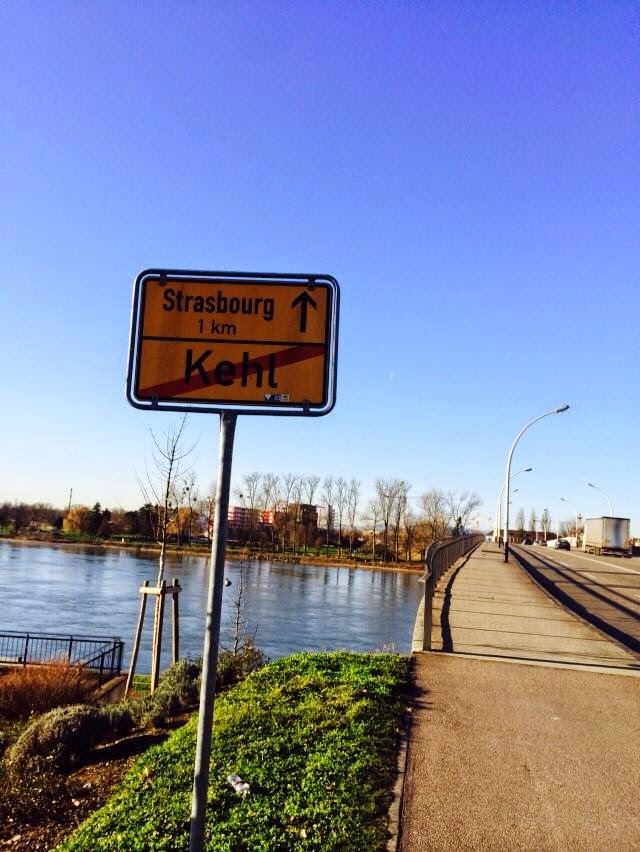
Before my eyes lays solely the River Rhine in the name of a ‘border.’ On the bridge over it, there are people riding their bicycles, walking their dogs, and lazily swinging their fishing rods in the river. As a traumatized Cypriot, who cannot travel across a tiny island without filling papers, showing identity cards and going through controls, my eyes impulsively search for a barrier, a wall, some sort of a barbed wire, a uniformed official, a police booth, or at least a ‘line’ on the ground - even if symbolic. I realize that I automatically reach inside my bag ready to ‘draw’ my ID any moment as I cross the bridge. I laugh at myself.

As I freely cross the bridge between France and Germany - the opposing sides of the Second World War, which was stage to unbelievable massacres only 70 years ago, I see the sign ‘Bundesrepublic Deutschland’ and understand that I am now in Germany. It’s a beautiful day. I decide to enter the park stretching along the River Rhine right at the entrance of the town Kehl. 

I first come across Yannick, a young 23-year-old teacher. His class of 3-4 year-old nursery students is with him. Under my scrunity, he talks to the children he has taken for a walk in the park both in German and French. He tells me that an increasing number of kids are learning both languages in the nursery, primary and elementary schools. Starting from secondary school both German and French are compulsory.

“The war was a stupid thing… We now live together. I am German but I don’t feel any different from someone who is French” he says. “Don’t you have any disagreements or problems at all?” I insist. “There is no difference between us. We are the same,” he says. His great-grandfather had fought against the French during the Second World War. “How do you think he would feel if he saw you living like this now?” I ask. “I am sure he would be very happy” he answers.

I leave Yannick with the kids, who are starting to get really bored, and continue to walk. My next target is Niklas, who is walking his dog. “Do you live here?” I ask him. “That’s a a difficult question,” he says. “Actually I live both in France and in Germany.” He must have understood my confusion, so he rushes to explain: “My girlfriend is here in Germany, and I work in France. Therefore, I sometimes live here, and sometimes there…” I ask him how it feels to be able to go back an forth like this between two countries with a history full of wars: “It’s wonderful to be free,” he says.

I approach another person who is taking a walk. Yann is a French taxi driver. He says he crosses to Germany every morning to walk in the woods. As I bombard him with questions impatiently, he calmly smiles at me and says, “The war was a long time ago. Is it so surprising that we have no discrimination amongst us anymore and that we live in peace?” Yes, unfortunately for me, it is suprising. I feel embarassed.

I get out of the park and walk towards the town centre of Kehl. A small market has been set up in the church square. I watch the salesmen and the people shopping. I hear them speak both in French and in German. At times, the conversations start in French and end in German. I approach a woman, whom, I gather must be French. I ask her why she is shopping here. “Because things are much cheaper here than in Strasbourg,” she replies. According to Ingrid, many people, who live in Strasbourg, do their food shopping in Kehl, which is cheaper. “But don’t French authorities react against this? You are contributing to the German economy instead of the French economy?” I hear myself asking. I understand from the way she looks at me that this question does not mean anything to Ingrid. It isn’t even comprehensible. She works at a French elementary school in Strasbourg. She explains to me that French kids take some of their classes at a school in Germany within the framework of exchange programs, and that some German kids come to her school for certain classes. I ask her what she thinks about the past. “The French and the German have realized that war brought them nothing,” she says. “If you want to live, you need to stop living in the past.”

From the people I speak with, I find out that around 60 thousand cars commute between Strasbourg and Kehl daily. A lot of French prefer to live in Kehl and work in Strasbourg since the property prices in Kehl are lower. They particularly shop for food, clothes, alchohol and cigarettes in Kehl, and buy luxurious goods in Strasbourg. They prefer Kehl for a quiet day in a small town, for taking walks and spending time in the park, and go to Strasbourg for a city life, cultural activities and entertainment. The majority speaks both languages with ease. The number of mixed schools are increasing each day. Especially the youngsters don’t see any difference between themselves and ‘the other.’

Just as I begin to think that such lack of ‘national consciousness’ is getting a little bit too much for my Middle Eastern mind, Ingo Wilmer comes to my rescue. He is a 53-year-old musician, who says that living on the French-German ‘border’ is sometimes “difficult” for him. “The youngsters speak both German and French. They live and work on whichever side they want. It is no longer possible to recognize who is French and who is German here. They have no national identity whatsoever,” he says. I see the annoyance in his face and hear it in his voice… He tells me that his father fought against the French during the Second World War. But immediately after, he adds: “What can we do, at least there is peace and quiet.”
As I walk back towards the bridge to return to Strasbourg, I feel a bit stupidified by this experience which has affected me more than I could have imagined... On the way to the bridge, I come across two singers on the street. The song they are playing is very familiar. My eyes fill with tears:

Imagine there’s no countries.
It isn’t hard to do
Nothing to kill or die for
And no religion too
Imagine all the people
Living life in peace...