Showing posts with label Article. Show all posts

Monday, 2 March 2015

CYPRUS – RETRIEVING THE PAST


ESRA AYGIN
Limassol – ASSOCIATED PRESS
24 June 2003, Tuesday 00:00

* EDITOR'S NOTE: Esra Aygin, a 23-year-old Turkish Cypriot journalist, crossed over to the Greek Cypriot south of Cyprus for the first time after Turkish Cypriot leaders eased a nearly 30-year travel ban. This is the account of her trip to her father's hometown in the south.


"Ozel, I knew you would come," shouted Andonis as he warmly hugged my father, who still couldn't believe he had found the man who saved him almost 30 years ago.

"You lost your hair," my father said, examining Andonis with curious eyes. "You got fat, Ozel," he replied, tapping my father's big belly. They had last seen each other in September 1974, when my parents fled their house in the southern city of Limassol for northern Cyprus after a Turkish invasion drove Turkish and Greek Cypriots to opposite sides of the island.

Last month, the Turkish Cypriot leadership eased a ban it had imposed on travel between the two sides, prompting more than 300,000 Greek and Turkish Cypriots to cross the line dividing Cyprus and visit their old houses and friends for the first time since the Turkish invasion.

My parents and I were among them. My father, now 65, always avoided talking about the clashes between Turkish and Greek Cypriots and the ensuing Turkish invasion. But the night before we went to Limassol, he told me about Andonis. As Turkish troops landed in Cyprus on July 20, 1974, the Turkish Cypriots in Limassol, including my parents and then 9-year-old brother, were detained by Greek Cypriot soldiers.

"We had no idea what was going to happen to us," said my mother, Yucel. "People were crying and begging the soldiers to let them free." After the family spent a night in custody, a Greek Cypriot soldier recognized my father as the physical therapist who had treated him some years before. "He drove us back home," my father told me. "And he told us not to leave the house. He was back at night with a basket with bread, cheese and a bottle of milk."

Adonis Ioannou, the young Greek Cypriot soldier, had risked his life to help my Turkish Cypriot family. My father hid for several days in fear of being rounded up again. It was a time when many people disappeared some in custody of Greek Cypriot soldiers _and my father sometimes wonders what would have happened had he not encountered Andonis.

About 1,000 Turkish Cypriots and some 1,500 Greek Cypriots are still listed as missing from fighting between the two sides in the 1960s and during the invasion, which was prompted by a short-lived coup by Greek Cypriot supporters of union with Greece. About 3,000 people were killed during those troubled times.

Nearly 200,000 Greek Cypriots from the north and 40,000 Turkish Cypriots from the south were displaced and divided by the "Green Line" that cuts across the Mediterranean island, home to nearly 1 million people, mostly Greek Cypriots. My father hid in the trunk of a Greek Cypriot's car to flee to the North. A British couple took my brother over the line, acting as if he were their son.

My mother pretended to be Greek Cypriot, burying her nose in a Greek newspaper as she crossed north in a car.

The easing of the travel ban was widely seen as an attempt to appease Turkish Cypriots frustrated at the collapse in March of talks on reunifying the island. Although Cyprus will join the European Union next year, the benefits of membership will apply only to the Greek Cypriot south and won't be extended to the Turkish-controlled north until Cyprus is again united.

Tens of thousands of Turkish Cypriots, including my parents, had taken to the streets to urge the leader of the breakaway Turkish Cypriot state, Rauf Denktash, to accept a U.N.-sponsored reunification plan. The state in the north is only recognized by Turkey, which maintains 40,000 troops on the island. It was an unnerving one-hour drive from the checkpoint in divided Nicosia to Limassol _ my first time in the Greek Cypriot south.

It was also the first time I saw my usually cheerful father crying like a helpless child as he stood on a wooden bridge across from the one-story house where he grew up. The house was gone, replaced by multistory apartment buildings.

My mother held on to him as they slowly and silently walked back to the car. "I feel like I have lost my childhood," my father told me later. "That house is gone, taking with it all my memories."

We stopped at a coffee shop to ask if any of the elderly customers knew Andonis. My father could only remember his first name _ and that his family had owned a grocery store.

After chatting in a combination of Greek and English over thick Cypriot coffee, a man offered to take us to Andonis.

He had been waiting for us. "I saw in my dream that you would be back," he said. "I had the same dream four times. This is a dream come true."

"This has been the best day of my life in the last 30 years," my father said as we slowly walked toward the checkpoint at the end of the day with two huge bottles of famous Cyprus wine and a camera full of photographs.

My mother, who grew up in a village called Moniatis on the Greek Cypriot part of the island, took a deep breath as if trying to trap the air of the "other side" in her lungs before reaching the checkpoint. She was 32 when she fled from the south.

"They stole 30 years from my life," she said, referring to the politicians' maneuverings that led to the island's decades-long division.

Reflecting on my parents' emotional return, I found myself recalling a Turkish Cypriot poem:
"My father tells me to love my country, But my country has been divided in two. Which side am I to love?"

Then I remembered what Andonis told my father: "We waited for peace for 30 years, Ozel. We can wait for another two or three."


Sunday, 22 February 2015

I Skipped Work Today - Crossing to the other side


Esra Aygin

Right now, I should be sitting at the birds-eye balcony allocated to media at the European Parliament, listening to the debate on genetically modified organisms (GMOs). However, since I set foot on Strasbourg to follow the plenary sessions of the Parliament, I have been having this burning urge to sneak out and cross the ‘border’ – or rather the non-existing border – between France and Germany and to speak to the people living in the area.


I have tens of questions that I would like to ask the people, who live together on the French-German border which, for centuries, was stage to terrible wars that took the lives of millions. What do they feel? How do they live together after countless wars, pain and destruction? Did they really manage to form a common life? Can hatred, distrust and enmity become something of the past? These questions roam in my head as I travel towards the ‘Pont de l’Europe Bridge’ in a taxi.

Suddenly, I am startled with the deep voice of the taxi driver:
“Voila madame, Le Pont de l’Europe!”

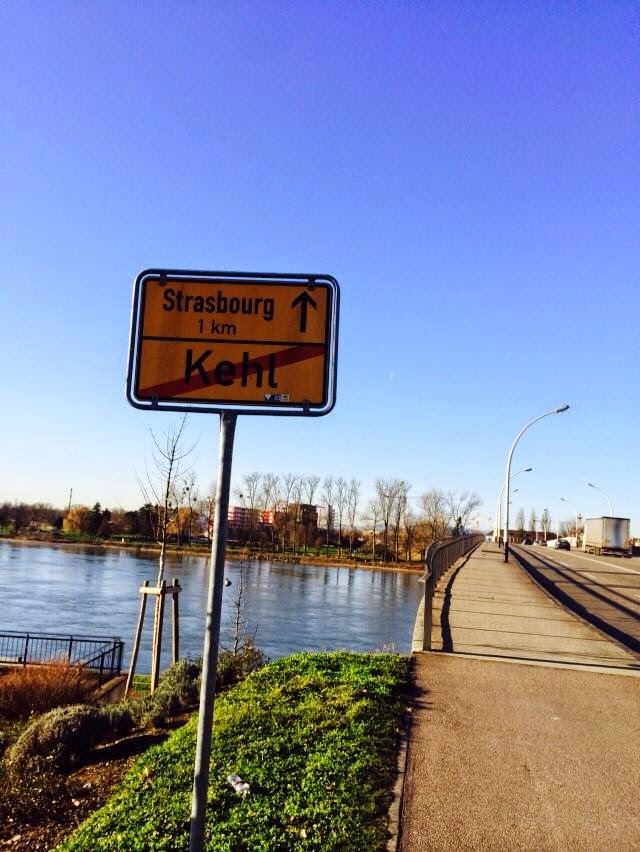
Before my eyes lays solely the River Rhine in the name of a ‘border.’ On the bridge over it, there are people riding their bicycles, walking their dogs, and lazily swinging their fishing rods in the river. As a traumatized Cypriot, who cannot travel across a tiny island without filling papers, showing identity cards and going through controls, my eyes impulsively search for a barrier, a wall, some sort of a barbed wire, a uniformed official, a police booth, or at least a ‘line’ on the ground - even if symbolic. I realize that I automatically reach inside my bag ready to ‘draw’ my ID any moment as I cross the bridge. I laugh at myself.

As I freely cross the bridge between France and Germany - the opposing sides of the Second World War, which was stage to unbelievable massacres only 70 years ago, I see the sign ‘Bundesrepublic Deutschland’ and understand that I am now in Germany. It’s a beautiful day. I decide to enter the park stretching along the River Rhine right at the entrance of the town Kehl. 

I first come across Yannick, a young 23-year-old teacher. His class of 3-4 year-old nursery students is with him. Under my scrunity, he talks to the children he has taken for a walk in the park both in German and French. He tells me that an increasing number of kids are learning both languages in the nursery, primary and elementary schools. Starting from secondary school both German and French are compulsory.

“The war was a stupid thing… We now live together. I am German but I don’t feel any different from someone who is French” he says. “Don’t you have any disagreements or problems at all?” I insist. “There is no difference between us. We are the same,” he says. His great-grandfather had fought against the French during the Second World War. “How do you think he would feel if he saw you living like this now?” I ask. “I am sure he would be very happy” he answers.

I leave Yannick with the kids, who are starting to get really bored, and continue to walk. My next target is Niklas, who is walking his dog. “Do you live here?” I ask him. “That’s a a difficult question,” he says. “Actually I live both in France and in Germany.” He must have understood my confusion, so he rushes to explain: “My girlfriend is here in Germany, and I work in France. Therefore, I sometimes live here, and sometimes there…” I ask him how it feels to be able to go back an forth like this between two countries with a history full of wars: “It’s wonderful to be free,” he says.

I approach another person who is taking a walk. Yann is a French taxi driver. He says he crosses to Germany every morning to walk in the woods. As I bombard him with questions impatiently, he calmly smiles at me and says, “The war was a long time ago. Is it so surprising that we have no discrimination amongst us anymore and that we live in peace?” Yes, unfortunately for me, it is suprising. I feel embarassed.

I get out of the park and walk towards the town centre of Kehl. A small market has been set up in the church square. I watch the salesmen and the people shopping. I hear them speak both in French and in German. At times, the conversations start in French and end in German. I approach a woman, whom, I gather must be French. I ask her why she is shopping here. “Because things are much cheaper here than in Strasbourg,” she replies. According to Ingrid, many people, who live in Strasbourg, do their food shopping in Kehl, which is cheaper. “But don’t French authorities react against this? You are contributing to the German economy instead of the French economy?” I hear myself asking. I understand from the way she looks at me that this question does not mean anything to Ingrid. It isn’t even comprehensible. She works at a French elementary school in Strasbourg. She explains to me that French kids take some of their classes at a school in Germany within the framework of exchange programs, and that some German kids come to her school for certain classes. I ask her what she thinks about the past. “The French and the German have realized that war brought them nothing,” she says. “If you want to live, you need to stop living in the past.”

From the people I speak with, I find out that around 60 thousand cars commute between Strasbourg and Kehl daily. A lot of French prefer to live in Kehl and work in Strasbourg since the property prices in Kehl are lower. They particularly shop for food, clothes, alchohol and cigarettes in Kehl, and buy luxurious goods in Strasbourg. They prefer Kehl for a quiet day in a small town, for taking walks and spending time in the park, and go to Strasbourg for a city life, cultural activities and entertainment. The majority speaks both languages with ease. The number of mixed schools are increasing each day. Especially the youngsters don’t see any difference between themselves and ‘the other.’

Just as I begin to think that such lack of ‘national consciousness’ is getting a little bit too much for my Middle Eastern mind, Ingo Wilmer comes to my rescue. He is a 53-year-old musician, who says that living on the French-German ‘border’ is sometimes “difficult” for him. “The youngsters speak both German and French. They live and work on whichever side they want. It is no longer possible to recognize who is French and who is German here. They have no national identity whatsoever,” he says. I see the annoyance in his face and hear it in his voice… He tells me that his father fought against the French during the Second World War. But immediately after, he adds: “What can we do, at least there is peace and quiet.”
As I walk back towards the bridge to return to Strasbourg, I feel a bit stupidified by this experience which has affected me more than I could have imagined... On the way to the bridge, I come across two singers on the street. The song they are playing is very familiar. My eyes fill with tears:

Imagine there’s no countries.
It isn’t hard to do
Nothing to kill or die for
And no religion too
Imagine all the people
Living life in peace...


Tuesday, 12 August 2014

Article - The real heroes of Cyprus (Published in Greek in 24h on 27 July 2014)

The real heroes of Cyprus

I watch in terror as the fighter jets rip the sky to mark the anniversary of Turkey’s military operation in Cyprus. They are here to celebrate, to remind the heroism, to mark the pride... My ears are deafened with their sound and I wonder how anyone can ever find this vulgar display of aggression entertaining. My blood freezes. I am petrified…

“I think it was a Saturday. We were in Tessera Fanarga in Limassol. All we heard were the sounds of mortars and guns… Mortars were being fired down on us continuously. So many of them, everywhere” said my father of the morning of 20 July 1974. “We were at the mercy of Greek Cypriots. And Greek Cypriots were at the mercy of Turkey.”  

The Turkish Prime Minister of the day – Bulent Ecevit, during the extraordinary parliamentary session on 20 July 1974 at the Turkish Grand National Assembly, had said: “This is a move not aimed at war but aimed at peace; to bring peace and freedom not only to Turks, but to all the people of the island, and not to seize a state but to re-establish a collapsed state on just foundations.”

Unfortunately, every step Turkey took after that day proved the opposite. Turkey was not here to re-establish the Republic of Cyprus but a new state of affairs. Turkey was here to stay…

A great show was put on last Sunday, complete with fighter jets and tanks. The TV overflew with endless outbursts of heroism, pride and fanaticism. And any Turkish Cypriot daring enough to criticise Turkey’s post- military operation policies, the “celebrations” or the status-quo, were called a number of names ranging from “ungrateful” to “bastard of Greeks” and were told to “go live in the south.”

I have found these celebrations, these outbursts of heroism nauseating ever since I was a kid. I have always believed that the real heroes of Cyprus are those, who keep silent. Those, who have suffered the most, who carried the real burden of all the painful events that ever happened in Cyprus, and those who still so faithfully long for a solution in Cyprus…


One of those mortars, being fired down on the Turkish Cypriot district of Limassol on that Saturday morning, 20 July 1974, fell within a couple of meters of my uncle – my father’s younger brother. He didn’t have time to escape. He suffered a major injury on his spinal cord. Last Sunday was also the 40th anniversary of him becoming paralysed from his waist down and becoming confined to a wheelchair. It was also the 40th anniversary of him, standing up for peace in Cyprus every day of his paralysed life. He was not among those shouting stories of heroism or cheering the fighter jets last Sunday. He was among those, who shut their windows to not hear the terrifying sound of war. To me, he is the real hero of Cyprus.

Article - We need to start telling the beautiful stories (Published in Greek in 24h on 20 July 2014)

We need to start telling the beautiful stories

There are terrible stories that can be told about 20 July 1974. Stories of war, bloodshed and fear. But today, I choose to tell you a beautiful story. A beautiful, true story I wrote in May 2003 when I was a 23-year-old journalist working for the Associated Press. The crossing points had just opened and we had gone to Limassol, together with my father and late mother to find Antonis, who had risked his life to help my family in July 1974.

May 2003

"Özel, I knew you would come," shouted Antonis as he warmly hugged my father, who still couldn't believe he had found the man who saved him almost 30 years ago.

"You lost your hair," my father said, examining Antonis with curious eyes. "You got fat, Özel," he replied, tapping my father's big belly. They had last seen each other in September 1974, when my parents fled their house in Limassol to come to Kyrenia.

My father had told me about Antonis the night before we went to Limassol. As Turkish troops landed in Cyprus on Saturday, July 20, 1974, the Turkish Cypriots in Limassol, including my parents and then 9-year-old brother, were detained by Greek Cypriot soldiers. My brother was sick, very scared and terribly weak.

"We had no idea what was going to happen to us," said my mother. "People were crying and begging the soldiers to let them free." My parents spent the night under detention at Yousoufidis’ clinic along with a large group of Turkish Cypriots living in Limassol. The next morning, Antonis, a young Greek Cypriot soldier recognized my father as the physical therapist, who had treated him some years before. "He rushed us into his jeep. Before taking us home, he drove to a doctor’s clinic, where he had your brother examined. He bought the medicines prescribed by the doctor and took us to our home," my father told me. "And he told us not to leave the house for a couple of days before things got calmer. He was back at night with a basket with bread, cheese and a bottle of milk." …

On arriving at Limassol that day, almost 30 years after my parents had fled the city, we stopped at a coffee shop to ask if any of the customers knew Antonis. My father could only remember his first name - and that his family had owned a grocery store. An elderly man recognised who we were talking about and offered to take us to his house.

It is unbelievable, but Antonis had been waiting for us. "I saw in my dream that you would be back," he shouted from his balcony after we rang the doorbell. "I had the same dream four times. This is a dream come true."