Showing posts with label north. Show all posts

Saturday, 6 January 2024

Crime heaven: corruption ‘worsening’ in north

By Esra Aygin 

1 January 2024 


Former Turkish vice president Fuat Oktay with Turkish Cypriot leader Ersin Tatar


‘Deterioration in terms of corruption has been evident in our reports’

Multiple bribery allegations surfacing over the past week involving senior Turkish and Turkish Cypriot officials have shaken the northern part of Cyprus and raised important concerns about the prevalence of corruption.

The first, which may indicate connections between politicians and mafia, involves former Turkish Vice President Fuat Oktay. Voice recordings published by Turkish investigative journalist in exile Cevheri Guven suggest that Oktay received $50 million (about €45 million) in bribes from the wife of gunned-down Turkish Cypriot mafia boss Halil Falyali.

According to the audio published on YouTube, Turkish Cypriot leader Ersin Tatar acted as a mediator along with a Turkish journalist Alihan Pehlivan in organising and coordinating the bribery.

The voice in the damning audio allegedly belongs to Falyali’s former accountant and close associate Cemil Onal, who is heard saying the bribe was paid “in exchange for not confiscating the Falyali family’s assets in Turkey and to end all investigations against them.”

Onal was recently arrested in the Netherlands in connection with Falyali’s murder and is currently in a Dutch prison, where he allegedly made the recordings. Guven claims that Oktay was replaced as Turkish vice president because word about the bribery got out.

Oktay, who at the time was also the Turkish minister responsible for Cyprus affairs, Tatar and Pehlivan have denied the allegations while Falyali’s wife Ozge has remained silent.
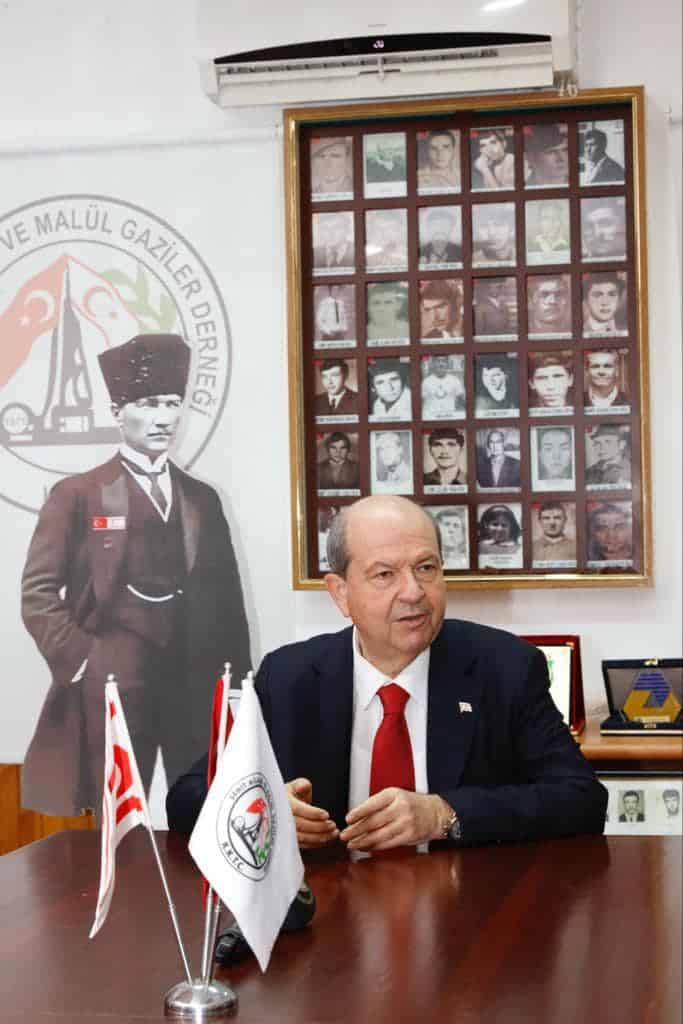
Turkish Cypriots leader Ersin Tatar


Hotelier, betting and casino tycoon Falyali was gunned down in February 2022 in a gangland-style execution involving Kalashnikovs and A47s while being driven home. His funeral was attended by high-ranking Turkish Cypriot politicians including Tatar.

Falyali, who was known as the main sponsor of the campaigns of Tatar’s National Unity Party UBP, faced criminal charges in the United States for money laundering. A 2015 US court affidavit said he rans“a large-scale drug and weapons trafficking organisation” in northern Cyprus and was “known to be associated with Turkish organised crime”.

In the same YouTube broadcast, Guven said Turkey has turned the northern part of Cyprus into a “crime heaven” and therefore, does not want a solution on the island or international recognition of the breakaway Turkish Cypriot state.

He also said this is why Oktay and other Turkish politicians intervened in the elections for the Turkish Cypriot leader in the north in 2020 in favour of Tatar.

“They clambered on [north] Cyprus, they literally staged a coup d’etat in the elections,” he asserted. “They got the man they wanted elected so that this… network of crime becomes stronger in [north] Cyprus; so that [north] Cyprus turns into a crime heaven for them; and so that they can fill their pockets… It has come to such a point that they don’t want [north] Cyprus to be recognised by the world or a solution there. They have themselves a grey area that is not recognised by anyone… and turned [it] into a crime heaven.”

Turkey’s interference in the 2020 elections was documented in an investigative report, which revealed shocking details of threats, pressures and blackmail against the incumbent leader Mustafa Akinci, as well as other candidates and journalists.

In a further bribery revelation in less than a week, a Turkish Cypriot businessman alleged on a live TV show that officials of the ruling right-wing coalition demanded a bribe in exchange for granting him a loan from the Development Bank.

Businessman Redif Nurel said Fikri Ataoglu, who is responsible for the tourism dossier in the north, and Hasan Tosunoglu, the then-chairman of the Development Bank demanded a bribe of 2.5 million Turkish Lira (about €77,000).

Nurel said he refused to pay the bribe and therefore never got his loan request approved.

Nurel also said that foreigners can “buy” Turkish Cypriot citizenship for 30,000 GPB (about €35,000).

Ataoglu and Tosunoglu filed a complaint with the police over the allegations.

These revelations “do not surprise me at all,” said Turkish Cypriot academic Sertac Sonan, who, with his colleague Omer Gokcekus, has been conducting annual studies on corruption in the north.

“The deterioration in terms of corruption has been evident in our reports,” Sonan told the Cyprus Mail. And it has got worse in the last three years, he said.

According to Sonan and Gokcekus’ latest study published in March and based on Transparency International’s Corruption Perceptions Index (CPI) methodology, the corruption perception score for the north for 2022, is 27 out of 100 (where zero indicates very high corruption and 100 no corruption). The north’s score was 40 when the academics first conducted the study in 2019.

“I am afraid there is a worsening trend,” added Sonan. These developments “demonstrate that we, as a society, are headed downhill.”

The score of 27 is far below the average score of 43 in 180 countries and places the north in the 140th position on the index along with Kyrgyzstan, Pakistan and Cameroon. The 2022 corruption perception score of Turkey is 36, placing it in 101st position, while that of the Republic of Cyprus is 52, placing it at 51.

According to the 2022 study, 40 per cent of the business executives interviewed resorted to bribery in the past year. Seventy-two per cent of the 350 interviewed said bribery and corruption was ‘very common’. Bribery was found to be most rampant among the ‘prime minister’ and ‘ministers’.

“Turkish Cypriots have gone through bad times but in terms of good governance, I don’t think we have seen worse,” Sonan said.

He added that the worsening trend over the past years has a lot to do with the current Turkish Cypriot right-wing coalition, which has very close ties with Ankara, seeing themselves as “irreplaceable.”

“They believe they will never be held accountable,” the academic said. “And this makes them more daring in putting their own personal interests in front of those of society.”

https://cyprus-mail.com/2024/01/01/crime-heaven-corruption-worsening-in-north/

Property-owning Jews in north increasingly targeted

By Esra Aygin

17 December 2023


Turkish Foreign Minister Hakan Fidan

‘The opposition to Israel’s actions against Palestinians has turned into an unconscious attack on all Israelis and Jews’

Since the Hamas attack on Israel in early October and Israel’s subsequent bombardment of Gaza, the Jews living in the northern part of Cyprus are increasingly becoming a target, particularly by nationalist circles.

The aggression often involves the disclosure of identities and in some cases photographs of Jews living among the Turkish Cypriot community on social media. The posts are widely circulated.

Most recently, a group led by Yasemi Ozturk, a member of the Turkish Cypriot assembly from the majority coalition partner right-wing National Unity Party (UBP), staged a demonstration in front of a Jewish centre, Chabad, in Kyrenia, calling it “a concrete step towards the building of a Zionist structure in [the northern part of] Cyprus”. Back in November, the Chabad building was sealed off by local authorities pressured by the same nationalist group on the grounds that it didn’t have the necessary documentation.

Late last month, five business organisations including the Cyprus Turkish Businesspeople Association, in a statement that condemned Israel’s attack on Gaza and called for a ceasefire, said: “The Jewish colony settled in our country should be controlled and the necessary measures should be taken regarding their residency here.”

“There is a very dangerous and concerning trend,” says Middle East expert professor Nur Koprulu. “Incriminating individual Jews or the whole Jewish community is antisemitism, hate speech and discrimination… What we cannot tell apart here is the distinction between the Jewish community and the Israeli state… And the stereotypes about Jews that are still very present in the society, are revived with negative developments such as war.”

She underlines that the trauma of war and killing of innocent people on both sides is also playing a big role worldwide which manifests itself at times as antisemitism and at times as Islamophobia.

Image from one of the newspapers accused of antisemitism


Property ownership

The aggression against Jews mainly focuses on their land and property ownership amid claims that they want to establish an Israeli state in northern Cyprus as part of the “Great Israel Project”.

Last month, a Turkish Cypriot nationalist journalist disclosed on social media the names of hundreds of real estate development companies owned by Jews along with their identities as well as their Turkish Cypriot partners under the heading “The Zionists among us.” The Jewish people identified in the post – also widely circulated in Turkey – were mostly the citizens of the unrecognised Turkish Cypriot state, which gives them the right to reside, buy property, and work freely in the north.

The antisemitic sentiment was exacerbated by a number of mainland Turkish media outlets that picked up on the post and did their own reports on the issue.

Sabah, which is among one of the biggest dailies in Turkey, claimed that there are 35,000 Jews living in northern Cyprus, who have bought 25,000 donums of land. The daily added that there are some 2,000 construction companies owned by Jews, which are building properties and selling only to Jews in the north.

“Israel is conquering TRNC [Turkish Republic of Northern Cyprus],” said Sabah.

Another Turkish daily, the Islamist Milli Gazete, claimed that “Zionists are amassing land in Cyprus, especially in areas that face Tel Aviv” and said an “unarmed invasion” is taking place.

International Relations associate professor Yonca Ozdemir warns against this mentality. “If there is any concern about the environmental, social or any other consequence of land sales then they should be looking at all sales,” she says. “It shouldn’t matter who is buying the land. Otherwise, this is antisemitism.”

“Who will be responsible of the horrific consequences of making targets of Jews, who have been living and investing in the northern part of Cyprus for decades?” asked journalist Pinar Barut at the online Ozgur Gazete newspaper. “The opposition to Israel’s actions against Palestinians has turned into an unconscious attack to all Israelis and Jews… Does this not bother the government and the law enforcement?”

The commotion about Jewish land ownership led a right-wing Turkish politician to ask Turkish Foreign Minister Hakan Fidan about “allegations that tens of thousands of donums of land in the north had been purchased by middlemen connected to Israel” in the Turkish parliament.

Fidan downplayed the Israeli property ownership but said that the land purchases by foreigners are being monitored since he was the chief of the Turkish intelligence agency MIT.

“We are conveying our concerns to the [Turkish] Cypriot authorities,” Fidan said.

Soon after Fidan’s statements, the department responsible for the interior affairs announced last week that it is preparing legal amendments that will bring limitations on property sales to foreigners.

“It is important to protect the land in the TRNC and not give it over to foreigners,” said Fikri Ataoglu, who is responsible for the tourism dossier in the north. “I don’t want TRNC land to be sold to anyone other than Turks.”

The amendments will not affect foreigners, who have been granted Turkish Cypriot citizenship.

“The territories of TRNC…were taken by guns,” wrote journalist Serhat Incirli in the daily Yeniduzen, after the announcement. “And now foreigners are buying these lands. The fuss is especially about some Israeli individuals or companies… Is there a problem if the looted territories are bought by Turkish companies rather than Israeli ones? No… We are being racist… Did we not steal the land over which we are fighting, being antisemitic, disgracing ourselves? The essence of the issue is very simple: ‘Fascists Turks cannot stomach that the stolen land is now being sold to some Israeli companies’.”

There has been a sharp increase in construction and property sales in northern Cyprus in recent years. Some 4,600 foreigners were given permission to buy properties in the first ten months of 2023. However, far more properties are being bought in the north by foreigners who have been granted Turkish Cypriot citizenships; by lawyers on behalf of foreigners; or Turkish Cypriot companies with “silent foreign partners” to avoid limitations imposed on foreigners. Official records do not show such transactions and estimates are that about 50 per cent of transactions are not recorded.

Is the north harbouring terrorism?

Meanwhile, Last Sunday, Israel said that it was “troubled” by use of the northern part of Cyprus “both for terrorism objectives and as an operational and transit area”. The statement described the north “as an area of activity and transit to attack Israeli and Jewish targets. [This] constitutes a disturbing issue.”

The statement came after Israel helped Republic of Cyprus foil an Iranian-ordered attack against Israelis and Jews on the island and captured two Iranian nationals. They were believed to have come to the Republic from the north.

Turkish Cypriot officials were quick to brush off Israel’s statement, with the speaker of the assembly Zorlu Tore labelling it as an “attempt to conceal the genocide it is committing in Palestine”.


https://cyprus-mail.com/2023/12/17/property-owning-jews-in-north-increasingly-targeted/

Tuesday, 5 December 2023

Ever-widening divisions between rich and poor in north

By Esra Aygin

December 3, 2023

Many families are surviving on less than the hunger threshold of €557 a month


The price of bread was recently increased by a further 20 per cent

A growing number of Turkish Cypriots live below the poverty threshold, while the income inequality between the richest and poorest segments of the society reaches unprecedented levels, a recent survey has revealed.

According to the 2021-2022 household budget survey conducted by the statistics institution in the northern part of Cyprus, almost 15 per cent of the population are currently living under the poverty threshold.

For comparison purposes, calculated with the methodology used in the European Union member states, the ratio increases to 22.8 per cent according to economists. This places the north among Romania and Bulgaria – the two EU countries with the largest percentage of people living below the poverty threshold.

The survey also shows that while poverty is growing, the high-income segment of the society is receiving a much larger percentage of the population’s total income. The Gini coefficient, which shows the degree of inequality in the distribution of income, is 0.37. According to economists, a Gini coefficient greater than 0.4 indicates that there is a big income gap in the society, which often leads to social and political instability or tension.

The survey results “show a huge inequality in income distribution, where the Turkish Cypriot middle class is fading into poverty, while the rich are getting richer,” economist Mustafa Besim explains to the Cyprus Mail. “The distortion in the distribution of income in the society has never been this bad.”

Besim highlights that GDP per capita has remained almost the same in the last 15 years – around 14,000 dollars – while the equality in distribution of income has deteriorated. The Gini coefficient in the previous survey conducted in 2015 was 0.33.

Hunger threshold

Making the situation grimmer, a calculation by the Cyprus Turkish Civil Servants Union KTAMS has revealed that a family of four earning the minimum wage is not only poor, but is in fact living below the hunger threshold.

According to KTAMS’ calculations, the hunger threshold – the amount needed to maintain a healthy, balanced and adequate diet – for a family of four as of October was 17,074 Turkish lira (about €557). The minimum wage is 15,750 Turkish lira (about €501).

“Those earning the minimum wage are left to starve,” Ktams head Guven Bengihan stated when announcing the findings. “People with minimum wage do not have the money they need to get enough food for their families.”

“I earn the minimum wage and have three children, who go to school,” Hamit Manga told the daily Yeniduzen a few weeks ago in a street interview. “I can only make ends meet because I do an extra job… I am worried about the future of my children. It looks like the only thing I will leave them will be debt.”

“It’s impossible to save money. We are only saving the day,” stated Mustafa Altinkalb in the same interview. “Many people are selling whatever they have just to survive. The rich have become richer, and the poor have hit rock bottom.”

“There is no middle class anymore,” said Mehmet Kadiri. “The rich lead super lives and the poor are struggling at the bottom… We are like a hopeless patient living on life support.”

Inflation

One of the main reasons that distorted the distribution of income to this extent is inflation, according to economist Besim. Turkish Cypriots have been going through one of the worst economic crises in their history since 2021 as the Turkish lira continuously declined in value against most major global currencies. Just this year, the Turkish lira lost 40 per cent of its value. This has led to soaring prices in the northern part of Cyprus, where the economy is dependent on imports.

According to the Statistical Institute, the annual inflation was 78.6 per cent in October. The monthly inflation was 1.9 per cent, while the monthly food inflation was recorded as 3.3 per cent. Earlier this week, the price of bread increased a further 20 per cent.

Although the official currency in the north is the Turkish lira and people’s salaries are also paid in lira, many expenses like rent and school fees are in foreign currencies, which exacerbates the situation. As Turkish Cypriots, especially those on low or fixed incomes, have experienced a huge drop in their purchasing power leading to a decline in their living standards, they have also seen their debts cascade as most borrowing in the north is done in foreign currencies.

Construction boom


Tens of thousands of houses are being built and sold mostly to foreigners in places like Trikomo

However, parallel to the increase in poverty and the income inequality, there is a huge amount of cash flow into some sectors such as construction and real-estate in recent years.

Ten of thousands of houses are being built and sold mostly to foreigners – mainly Russians and Iranians – in areas like Kyrenia and Iskele/Trikomo. Lack of reliable statistics and the overall problem of the unregistered economy makes it impossible to calculate exactly how big the construction and real estate sector is, but economist Merkan Hamit roughly estimates, looking at the construction projects and the prices, that property sales generate an annual 1 billion dollars in the north. This is almost one thirds of the gross domestic product.

It is estimated that the unregistered economy amounts to 80 per cent of the total economic activity.

According to the Chamber of Shopkeepers and Artisans (Ktezo), while small businesses, particularly in the food and beverage sector, are steadily going out of business, brokers, consultants and real estate agents, primarily run by foreign citizens, are taking their place. Data from Ktezo show that half of the small food and beverage businesses opened in recent years have closed down, while almost one third of new workplaces that have opened so far this year are linked to the real estate sector.

“There is a lot of economic activity in certain sectors, but due to a lack of effective public policies from adequate regulations, to controls and taxation policies, the revenue that is generated is not distributed equally to the society,” says Besim. “While certain segments of the society are getting ridiculously rich, others are not able to benefit from this economic activity… There is a very rich group on the one side, and then a very poor group on the other.”

The income inequality and the ensuing shrinking middle class has serious social implications, according to Besim.

“As the middle class becomes poorer, it starts spending its income solely on the basics such as food, health and shelter,” he explains. “The smaller the middle class, the smaller segment of the population spends on education, arts, culture. This completely distorts the social structure of the society as a strong middle class is required for a strong democracy. The lack of a strong middle class means those in power aren’t questioned or criticised. It is easier to govern societies with such a big income inequality. Unfortunately, this is where we are headed.”

https://cyprus-mail.com/2023/12/03/ever-widening-divisions-between-rich-and-poor-in-north/

Stark increase in north’s population

By Esra Aygin

November 5, 2023

Numbers could be up as much as 40 per cent since 2011


Some 60,000 new homes were sold in the last seven years, the majority of which were bought by foreigners

The population of the north may have increased by as much as 40 per cent since the last census in 2011, compared with a ten per cent growth rate in the south of the island, sparking a furious debate on why Turkish Cypriots are being left to ‘guesstimate’ how many of them are left and if they themselves have become a minority.

“We know the population!… There are some numbers that you can talk about and some that you cannot. There are some things that cannot be said,” lashed Unal Ustel, head of the Turkish Cypriot ruling coalition, on live TV recently when asked why there are no plans to do a census in the northern part of Cyprus.

Besides leaving the presenter and viewers speechless, the statement once again ignited the debate about the mystery around the population living in this part of the island.

“What is it that you can’t talk about?” opposition deputy Dogus Derya immediately took the social media. “What are you trying to hide? That we have become a minority in our own country?”

The last census in the north was done in 2011 with unofficial United Nations supervision and found the de jure population to be some 286,000, excluding Turkish military and their families residing in military bases. Although there were widespread reports of undercounting, this is the only figure that the Turkish Cypriot statistics office currently has, to make projections.

Taking the 2011 census as a basis, the office has recently announced a projected population of almost 400,000 as of the end of 2022. This figure was found unrealistic by most including the head of the statistics office Irfan Tansel Demir himself, who acknowledged that the projection has a considerable margin of error because of the time that has passed since the last census in 2011. Demir also raised questions about the accuracy of that census “because many people were not found at home.”

Even with these official numbers, however, the increase in population is stark. The difference between the 2011 census and the 2022 projection points to an almost 40 per cent increase in population in 11 years. The population growth rate in the Republic of Cyprus during the same period was less than 10 per cent.

Senior researcher Mete Hatay from PRIO Cyprus Centre, who has done extensive research on the population in the northern part of Cyprus, says that the projection only takes into account criteria such as fertility and death rates of the community and does not include the vital – and presumably huge – number of those, who are working in the black economy or who have overstayed their visas.

“We know that the population is at least half a million, but we don’t have the necessary details to make a healthy estimate,” says Hatay. He adds that “in any case, at any given moment, Turkish Cypriots are a minority in the northern part of Cyprus.

Turkish Cypriots in every walk of life feel the consequences of the overpopulation. Last month, the Cyprus Turkish Teachers Union (KTOS) official Akgun Kacmaz, talked about the shortness of teaching staff and mentioned that container classrooms had been set up in many public schools to manage the student numbers due to the increasing population.

Izlem Gurcag, who was responsible for the health dossier of the northern part of Cyprus, admitted in August as she was leaving her post that, “Our financial resources are not enough for the population that is cascading every day.”

Hatay says that as well as the size, the composition of the population in the north is also changing rapidly. Whereas until a few years ago the non-Turkish Cypriot population was almost exclusively Turkish, recently there is a tremendous number of people from other countries flowing into the north.

Currently there are some 110,000 foreign university students in over 20 universities in the north – mostly from Africa, Arabian Peninsula, Africa, Middle East, and Far East. They come to the northern part of Cyprus on a student visa, which is very easy to get. For the first time this year, the number of students from these third countries exceeded the number of students from Turkey.

The last couple of years also saw a huge increase in the Russian and Iranian population in the northern part of Cyprus. Russian news agency Itar Tass reported a few months ago that some 50,000 Russians live in the northern part of Cyprus, where Kremlin recently started mobile consular services. According to the official data by the tourism department, only in January-September this year, some 39 thousand Russians and 33 thousand Iranians came to north through the sea and airports.

“We don’t want to know”

Researcher Hatay argues that there is a deliberate political decision not to make any census “because we don’t want to know.”

“First of all, the more ambiguous the population numbers are, the more it can be politicised,” asserts Hatay.  “Everyone benefits from the ambigiouty. Some ask for more money based on inflated numbers, some use the ‘Turkish Cypriots are becoming extinct’ fear to get votes.”

But more importantly, according to Hatay, a census would reveal certain realities on ground, such as the alarming number of people – mostly university students – working in the black economy.

“A huge system of exploitation has been set up through universities,” says Hatay. “There are slave students here.”

The higher education sector, which is one of the main engines of the Turkish Cypriot economy, has grown in an uncontrolled fashion as the policy has been to open as many universities and attract as many foreign students as possible. According to the US State Department’s Trafficking in Persons Report in 2022, in many cases, foreign students are promised low tuition fees, accommodation and access to good jobs. Once in the northern part of Cyprus, they end up being exploited as cheap labour, or forced into prostitution or drug trafficking. Some are smuggled into the Republic of Cyprus.

According to Hatay, not doing a census also serves conveniently to obscure the size of certain groups of people in the country.

These groups do not just consist of Turks anymore – whose increasing presence in the north has always been contentious.

“They especially don’t want to talk about the foreign property owners,” says Hatay.

According to Hatay, some 60,000 new homes were sold in the last seven years, the majority of which were bought by foreigners. The numbers in the official gazette show that the number of foreigners – mostly Russians – investing in property has significantly increased as of November 2022, which coincides with the sanctions on Russian nationals due to the war in Ukraine. Russians can easily buy property in the northern part of Cyprus as banks here are not part of the international Swift system and operate via Ankara, which has not put sanctions on Russia. There currently are a further 15,000-20,000 thousand ongoing construction of homes. According to economist Merkan Hamit, looking at the construction projects and the prices, it can roughly be estimated that the property sales generate an annual 1 billion dollars, which is almost one thirds of the gross domestic product of the northern part of Cyprus.

Turkish Cypriot judiciaries have recently been warning about a risky money circulation in the northern part of Cyprus, whereby large amounts of money are coming in for real estate purchases but then going completely unchecked.

In some cases, these foreign property owners have been revealed as individuals wanted by Interpol. Earlier this week, Russian citizen Vladislav Apakov wanted by Interpol for embezzling large amounts of money, was found to be residing in the north. In June, another Russian national Stanislav Mitrushi wanted by Interpol for money laundering, was arrested in the north. Last year, Australian fugitive Mark Buddle also wanted by Interpol for links to a transnational criminal syndicate was arrested in the north, where he had acquired a sizeable amount of property. The recently published Global Organised Crime Index 2023 states that “In areas not under the effective control of the Republic of Cyprus, there are a number of people wanted by Interpol.”

Considering how important the higher education and real-estate sectors are for the economy of the northern part of Cyprus, this order of exploitation and illicitness needs to continue, and it can only continue if the ambiguity continues.

“The northern part of Cyprus, which has long been isolated from the world, has now integrated with the world through a system of exploitation and illicitness,” concludes Hatay. “And the long-standing controversy and speculation surrounding the population serves to maintain this. For this to continue, we have to not know.”

https://cyprus-mail.com/2023/11/05/stark-increase-in-norths-population/

Anger over administration-sanctioned Quran courses in north

By Esra Aygin

July 30, 2023


Secularism under threat as summer courses for children offered in mosques


Children in a mosque receiving instruction in the Quran during their summer break (Yeniduzen)

“Today, the tyranny of secularism [in the northern part of Cyprus] has matched the tyranny of Greek Cypriots. This secularist tyranny…must end now.”

These were the words of Ali Yıldız, the president of the Turkish trade union Diyanet-Sen, which represents employees of the Directorate of Religious Affairs in Turkey. Yıldız was reacting to the backlash in the secular and modern Turkish Cypriot community against Quran courses targeting minors in mosques during the summer.

Online Turkish Cypriot newspaper Bugun Kıbrıs revealed that the Turkish Cypriot education authorities had given permission for children to be taught the Quran by imams in mosques during the summer break.

In recent years, Quran courses were being offered illegally in mosques by imams without the permission of the Turkish Cypriot education department, which feared the reaction of the Turkish Cypriot community. Police occasionally raided these courses. As revealed by Bugun Kıbrıs, the Turkish Cypriot education department now seems to have bent under the pressure, and on July 3 gave official permission for Quran courses for children at mosques.

In 2021, the Turkish Cypriot constitutional court had ruled that Quran courses cannot be organised without the permission, supervision and control of the Turkish Cypriot education department, drawing the fury of Turkish President Recep Tayyip Erdogan.

“We will never tolerate steps that impede the Quran education of our children in northern Cyprus,” Erdogan had responded and urged the Turkish Cypriots to fully adopt Turkey’s practices on religious education.

“The notion of secularism is not what they imagine it to be and northern Cyprus is not France,” he had asserted.

The Bugun Kıbrıs newspaper ran photos of young boys and head-scarved girls attending these courses, where they are offered fruit juices, ice cream and other sweets. It also reported that the imams could, every now and then, be heard shouting at the children.

The courses are especially appealing to lower-income families, who need to go to work and do not want to leave their children alone at home during the summer months.

The Turkish Cypriot ruling coalition and the education department was under heavy criticism from the media, civil society organisations, opinion leaders and some politicians for giving permission for the Quran courses.

“The education ministry is committing a crime by allowing minors to be taught by imams with no pedagogical formation, who deceive and brainwash them with ice cream,” stated Selma Eylem, head of the Cyprus Turkish Secondary School Teachers Union Ktoeos.

Calling this an attempt to make Quran courses a part of formal education, Eylem added that these courses are part of the social engineering being carried out by Erdogan’s Justice and Development Party AKP.

While most Turkish Cypriots consider themselves Sunni Muslims, they practise a very peaceful and moderate version of Islam in contrast with the Turks of Turkey. Among the most liberal Muslims globally, Turkish Cypriots are not influenced by organised religion, rarely attend mosques, and adhere to a very strict form of secularism. The Turkish Cypriot constitution safeguards secularism in the northern part of Cyprus.

Mine Atli, head of the Social Democracy Party TDP, agrees that the Quran courses at mosques are part of the efforts of Ankara to change the secular characteristic of the Turkish Cypriot community.

“All this is being done under the name of ‘freedom of religion,’ but these courses are completely based on Sunni Islam,” says Atlı. “We will not remain silent in the face of this crime committed against our children. We will not let our country drown in the darkness of AKP.”

“Education should be given at schools by teachers,” the main opposition Republican Turkish Party CTP said in a written statement. “We are against reactionary impositions and illegal practices aimed at social engineering.”

In recent years there is an undeniable Islamisation in the northern part of Cyprus with the Turkish government providing significant support to Sunni Islamic activities here. Consequent economic protocols signed between the Turkish Cypriot administration and Ankara introduce conditions that constantly aim to consolidate the role of Islam in Turkish Cypriot society from strengthening the religious affairs department, to organising religious youth camps to building more theology schools, religious complexes, tekkes and shrines.

The backlash in the Turkish Cypriot community against the Quran courses grew even bigger with the statements of Diyanet-Sen president Yıldız from Turkey, who continued:

“49 years ago, the Turkish army risked their own lives and protected… our [Turkish] Cypriot brothers from the Greek invasion and the Greek Cypriot tyranny… Now a group in the northern part of Cyprus, which characterises itself as secular, and which has a mentality parallel to that of Greeks, is trying to eliminate all religious beliefs and values from public space, including education. What needs to be fought against is this mentality. Not those, who teach and study our glorious book Quran.”

A few days later another provincial head of Diyanet-Sen, Mehmet Akif Gerboga added flames to the fire by stating:

“The tyranny of this group, which is an enemy of Islam…is the same as the tyranny of Greek Cypriots. The tyranny of this group, which poses as secular, should end… We believe that the Turkish Cypriot people deserve neither the tyranny of Greeks nor this group, which has no national or moral values.”

Underlining that secularism is not only safeguarded in the Turkish Cypriot constitution but also the Turkish constitution since 1937, former ombudswoman and retired judge Emine Dizdarlı, said no one has the right to meddle with and attack the Turkish Cypriot way of life.

“Secularism is not tyranny, it is civilisation,” asserted Kudret Ozersay, head of the People’s Party HP, on his social media account. “It is the safeguard of all freedoms, and mainly freedom of religion and faith. Nobody has the right to present the secularism of Turkish Cypriots as blasphemousness.”

Burak Mavis, secretary general of the Cyprus Turkish Teachers Union Ktos, during a press conference last week, said small children are being subjected to religious exploitation at the Quran courses and defined these as part of efforts to institutionalise sharia law.

Cyprus Turkish Civil Servants Trade Union Ktams head Guven Bengihan agreed:

“Recently there are attacks against the Turkish Cypriot secular way of life. There are planned efforts to establish an anti-secular system here.”

“Religious culture and moral knowledge” classes, which basically consists of teaching Sunni Islam became a compulsory subject in Turkish Cypriot schools in 2009, with most teachers coming from Turkey. In 2012 the Hala Sultan theology college was inaugurated. Currently there are plans to establish a second theology college in Famagusta. Turkish financial support has been instrumental in these activities, funnelled via the assistance office at the Turkish embassy in Nicosia.

Many Turkish Cypriots feel threatened by the Islamic hegemony culminating in more and larger mosques, Quran courses, plans to establish more theological schools, more conservative imams and religion teachers coming from Turkey, the mushrooming religious cults and sects, and attempts to change the Turkish Cypriot education system.


https://cyprus-mail.com/2023/07/30/anger-over-administration-sanctioned-quran-courses-in-north/

North’s electricity deal with Turkey as elusive as ever

By Esra Aygin

July 2, 2023


The north suffered a total of 5,277 power cuts in 2022, two times worse than in Pakistan


Teknecik power station in the north

Plans to create an electricity cable link from Turkey to the northern part of Cyprus are far from transparent, with experts warning that if the interconnection method isn’t implemented, the Turkish Cypriot electricity woes would be worsened rather than alleviated.

In recent weeks, newly re-elected Turkish President Recep Tayyip Erdogan and his vice president Cevdet Yılmaz, who paid separate visits to the island, listed among their priorities an undersea electricity cable project from Turkey to put an end to the power cuts in the north. This was taken as a sign that the project that has been voiced occasionally for the last decade will finally materialise.

Turkish Cypriots have been suffering from sweltering power cuts mainly due to lack of necessary investments in the electricity infrastructure and frequent fuel shortages. There were a total of 5,277 power cuts in 2022 according to economist Mertkan Hamit, which makes the country two times worse than Pakistan with the worst average monthly electricity supply according to World Bank data.

Moreover, as electricity is mainly produced using imported fuel oil, high electricity prices due to the volatility in fossil fuel prices, the war in Ukraine and the depreciation of the Turkish lira, are crippling the community. The price of electricity increased by over 190 per cent since the beginning of 2022, according to the figures from the Turkish Cypriot statistics department.

But will the undersea cable project, which according to Turkish ambassador Metin Feyzioglu, would cost US$780 million (€717 million) solve the problem?

While the finer details of the cable project have not been made public, experts are expressing concern over the lack of transparency and warning that if the plan is to merely buy electricity from a power generator in Turkey through a one-way system rather than an interconnection permitting a two-way transmission of electricity between Turkey and the north, this would worsen energy supply security and further increase prices.

“I fear that the project on the table right now might merely be an electricity transfer without interconnectivity,” says Ozdil Nami, who was responsible for the energy dossier in the north between 2018 and 2019.

“The truth of the matter seems to have changed.”

There are political difficulties in front of establishing an interconnection with Turkey, as the country is an observer member of the European Network of Transmission System Operators for Electricity (ENTSO-E), energy economist and electrical engineer Yusuf Avcıoglu explains to the Cyprus Mail.

ENTSO-E, which unites European Union member states’ transmission grids, was established by EU countries in 2009 to increase energy supply security. There is a permanent connection between Turkey and the ENTSO-E’s Continental Europe grid since 2015 via Bulgaria and Greece.

“ENTSO-E is the ultimate arbiter regarding the connection of a third state to the main grid,” says Avcıoglu, who is also the former vice-chairman of the board of directors of the Turkish Cypriot electricity authority Kıb-Tek. “Therefore, ENTSO-E’s permission and approval is needed for any interconnection made by Turkey.”

According to Avcıoglu, as long as the Cyprus problem remains unresolved, ENTSO-E will not grant a permit to Turkey to make an interconnection with the northern part of Cyprus, and the only method that can be approved and implemented at the moment is the “isolated area feeding” method.

This is exactly the method the experts are warning against.

“This means electricity can only be transmitted one way by Turkey to the north through a power generator set up separately from the main grid,” Avcıoglu says. “This is not interconnection. A two-way transmission will be impossible. We would not be able to export the power generated by solar energy.”

Besides a solar farm, households in the north have the right to set up solar panels and sell to the grid.

A simple one-way cable rather than an interconnection would be detrimental for the Turkish Cypriot community Nami tells the Cyprus Mail.

One of the biggest risks is becoming dependent on the electricity supply from Turkey.

According to reports, the cable from Turkey “will meet one thirds of the total demand. This is a huge share. The smallest problem or failure would make the country plunge into darkness,” says Nami. “On top of that, we would not be able to sell our extra electricity generated by solar panels and the electricity prices would spike because the investment cost of this huge project plus all the operational and other expenses would be reflected in the electricity bills.”

In this case, it is vital that other alternatives are considered, experts say.

Caglayan Cesurer, the president of the Cyprus Turkish Electricity Authority Workers Union (EL-SEN), also made a statement warning about the risks or the project.

“If you connect the north to Turkey through a system which will allow us to buy electricity when needed and to sell electricity when needed, then go ahead,” said Cesurer. “But what you are trying to do here is to set up a system for a one-way purchase from a power generator in Turkey. At all costs, we will never allow a one-way sales agreement with Turkey through a cable.”

A question that arises at this point is, would Turkey, which has an income of about €2 billion per year as a result of its membership in ENTSO-E, go ahead with an interconnection with the northern part of Cyprus and risk being sanctioned?

“It is possible,” says Nami. “It is totally up to the political will of Turkey.”

Nami says that during his tenure in 2018, there was not enough political will on the part of Turkey to push forward with this.

“Turkish officials wanted to realise the project but also did not want any problems with ENTSO-E.”

However, Nami also relays to Cyprus Mail that during his meeting with ENTSO-E officials in Brussels the same year, he was told that Turkey would not be massively sanctioned if it went ahead anyway and made an interconnection with the north without ENTSO-E’s permission, as many member countries are benefitting significantly from Turkey’s presence on the grid.

As the Turkish Cypriot community awaits to find out about the details of the cable project,

Olgun Amcaoglu, who is currently responsible for the economy and energy dossier in the north, recently told reporters that the Turkish Energy and Natural Resources Minister Alparslan Bayraktar “has assured us that there would not be any problems with ENTSO-E”.

Clearly clueless about the plans, Amcaoglu concluded: “President Erdogan also conveyed to us that they are taking full responsibility.”


https://cyprus-mail.com/2023/07/02/norths-electricity-deal-with-turkey-as-elusive-as-ever/

Easy student visas in north are driving human smuggling

By Esra Aygin

May 28, 2023

Many students never attend university and are either trafficked or enter the Republic


A group arrested while conspiring to smuggle people to the Republic (Yeniduzen)

The ease with which student visas are issued, the inadequate legal framework, and the general lack of controls in the northern part of Cyprus is increasing human smuggling and trafficking through universities.

There are 22 universities there, which has a population of less than 500,000, hosting some 104,000 students on paper. Close to half of these students are from third countries in the Arabian Peninsula, Africa, Middle East, and Far East. They come to the northern part of Cyprus on a student visa, which is very easy to get.

All any prospective student needs to do is to make an online application to any of the universities, pay the fee and register, explains education expert and academic Salih Sarpten. Once they are registered with a university, they get a plane ticket and arrive at Ercan/Tymbou airport, where they are given a one-year student visa when they show the printout of the proof of the university registration.


Young men arrested while trying to cross the Green Line and into the Republic (Yeniduzen)

“Once they are in the country, there is no mechanism to check where they are or what they are doing,” says Sarpten. This coupled with the inadequate legal framework has allowed many students to “disappear”.

“A considerable number of new students on the list handed to the academics at the beginning of the year, are missing from the classroom,” said Sarpten.

Fezile Osum, who is the Anti-Trafficking and Refugee Rights programme coordinator at the Turkish Cypriot Human Rights Platform, underlines that these students are largely in the hands of human traffickers and human smugglers.

Nazim Cavusoglu, who is responsible for the education dossier, recently told the AFP news agency that there are some 15,000 “passive” students, who have entered the country on a student visa, but are not attending any classes. Sarpten believes the number of students unaccounted for is no less than 30,000.

“Thirty per cent of the total number of students is missing,” said Sarpten. “Which suggests that they are either employed in the black economy; they are in the hands of human traffickers engaged in illegal activities such as sex or drugs trafficking; or they have already found their way into the European Union” through human smugglers across the porous Green Line dividing the island.

The higher education sector, which is one of the main engines of the Turkish Cypriot economy, has grown in an uncontrolled fashion in the last two decades as the policy has been to open as many universities and attract as many foreign students as possible.

“Higher education here is an economic sector,” says Sarpten. “Universities survive not on science, research, or patents, but on the money from students.”

This has led universities, some of which are owned by big businessmen, who in some cases also own casinos, to work with agents to find prospective students mainly from impoverished third countries and bring them to the universities. In return they get a commission.

Human trafficking

The ease with which student visas are issued, and lack of controls or supervision over whether individuals on a student visa are indeed going to school, have given rise to malicious agents, who take advantage of the system to exploit students. According to the US State Department’s Trafficking in Persons Report in 2022, in many cases, these agents falsely promise students low tuition fees, accommodation and access to good jobs in an EU member state. Once in the northern part of Cyprus, they end up being exploited as cheap labour, or forced into prostitution or drug trafficking.


Two Bangladeshis on student visas arrested after trying to enter the Republic (Yeniduzen)

Osum explained that out of 23 identified human trafficking victims in 2022, 18 of them had entered the island with student visas.

Last year, a Turkish rights group and the Nigerian National Agency for the Prohibition of Trafficking in Persons (NAPTIP), published a communique calling the northern part of Cyprus a “heaven for the traffickers who operate unrestrained”.

“Students can receive visas mostly with just a proof of university registration,” the communique explained. “It has been understood that the human traffickers have been abusing this procedure.”

The student visa can easily be renewed by re-registering in different higher education institutions while on the island.

Human smuggling

Human smugglers also exploit the ungoverned higher education sector to offer young people on a student visa a path to Europe.

“Not all of these students come here to study,” said Sarpten. “A significant number of them want to leave the difficult conditions in their countries… They take advantage of the simple student visa procedure to come here, and once they are here, they try to find ways to get into the Republic of Cyprus or other European Union member states.”

“We witness this a lot in the field,” Osum agreed. “Because student visas are very easy to get, the students come here to the north, and then cross to the south with the help of smugglers. We also know that the people applying for asylum in the Republic of Cyprus are mostly those, who arrive on the island using universities and student visas.”

Figures from the United Nations High Commissioner for Refugees (UNHCR) confirm this trend. From January to March 2023, some 3,182 persons have applied for asylum in the Republic of Cyprus.

“It is etablished that the vast majority of the asylum seekers in Cyprus arrive via the north,” UNHCR communications officer Emilia Strovolidou told the Sunday Mail.

Strovolidou explained that as of 2020, increased numbers of refugees and migrants from Africa and Asia arrive by air in the northern part of Cyprus on student visas and then clandestinely cross to the Republic of Cyprus to apply for asylum. 

In fact, last August, two Bangladeshi nationals were held up around the Yigitler Burcu/Roccas (Kaytaz) Bastion in Nicosia as they were attempting to cross to the Republic of Cyprus. The two men had paid smugglers €6,000 each and had been brought to the north on student visas issued in their names after they were registered in a university. For another €150 each, they were taken to the Yigitler Burcu and instructed to cross the Green Line to the Republic of Cyprus. Police believe the same smugglers have brought 322 Bangladeshis to the northern part of Cyprus through this scheme during the 2021-2022 academic year by registering them with five different higher education institutions.

“There is no population policy,” Sarpten emphasised. “There is no higher education policy. There is no policy on how many foreign students will be admitted in universities. There are no university entry criteria. All this is an invitation for the human traffickers and human smugglers.”


https://cyprus-mail.com/2023/05/28/easy-student-visas-in-north-are-driving-human-smuggling/

Corruption is rife in northern Cyprus

By Esra Aygin

March 12, 2023


North is 140th on the corruption index along with Kyrgyzstan, Pakistan and Cameroon


Turkish Cypriot coalition head Ünal Üstel (yeniduzen)

A comprehensive study on corruption conducted in the northern part of Cyprus has revealed that it is extremely widespread, with 40 per cent of the business executives interviewed having resorted to bribery in the past year.

Seventy-two per cent of the 350 interviewed said bribery and corruption was ‘very common’.

Bribery was found to be most rampant among the ‘prime minister’ and ‘ministers’.

According to the study, which was based on Transparency International’s Corruption Perceptions Index (CPI) methodology, the corruption perception score of the north for 2022, is 27 out of 100. On a scale of 0-100, zero indicates very high corruption and 100 indicates no corruption.

Transparency International, which publishes the corruption perception scores annually for 180 countries, does not cover the unrecognised northern part of Cyprus. Hence the need for this study by academics Sertaç Sonan an Ömer Gökçekuş, with the sponsorship of German Friedrich-Ebert-Stiftung (FES) foundation, to measure the perception of corruption and to determine where it stands compared to the rest of the world.

The score of 27 is far below the average score of 43 in 180 countries and places the north in the 140th position on the index along with Kyrgyzstan, Pakistan and Cameroon. The corruption perception score of Turkey is 36, placing it in 101st position, while the corruption perception score of the Republic of Cyprus is 52, placing it at 51.

“This score is definitely worrying,” says Sonan, one of the academics, who conducted the study. The countries below us are the failed states most of which are going through civil wars.”

The study done for the sixth consecutive year demonstrates that corruption is on the rise. When the first study was conducted in 2017, the score for the north was 41.

As part of the study, a survey was given to 350 business executives, who are in senior managerial positions of companies. A separate survey was given to a group of retired high-level civil servants, who well know how the public sector mechanism works.

99 per cent say there is bribery and corruption

According to the findings, a staggering 99 per cent of the business executives, who participated in the study, say that there is bribery and corruption with 72 per cent believing they are ‘very common,’ while 54 per cent believe that corruption has worsened compared to the previous year. Ninety-four per cent of them said corruption is an obstacle to doing business.

Forty per cent of the business executives admitted to giving bribes, gifts or doing a favour to a civil servant in the last year to expedite or finalise work, or to get favourable treatment.

Sonan believes the real number is well above 40 per cent as it is difficult for anyone to say ‘I gave bribes.’

According to the business executives, bribery or ‘undocumented extra payment’ is most common in public tenders, issuing permissions and licences, giving incentives and allocating and leasing public land and buildings. It is least common in obtaining favourable judicial decisions.

Those surveyed mostly held politicians responsible for corruption. According to 84 per cent, corruption is ‘very common’ among ‘prime minister’ and ‘ministers.’ These are followed by members of the Turkish Cypriot assembly (76 per cent) and high-level civil servants (69 per cent). While 33 per cent said corruption is ‘very common’ among lower-level civil servants, 22 per cent said corruption among prosecutors and 20 per cent said corruption among judges are ‘very common.’

The study shows that the participants’ trust in institutional mechanisms that are expected to prevent corruption is quite low. Eighty per cent said the ‘government’ is ‘not successful at all’ in fighting corruption. Seventy-two per cent said officials involved in corruption are not prosecuted. According to participants, the most effective institution in the fight against corruption are courts, but only by 16 per cent. 


Political corruption

The survey also gave indications about political corruption. Seventy-five per cent of those surveyed said that it is common to buy votes or offer special favours during election periods. Thirty-four per cent said voters are frequently threatened with punishment unless they vote in a certain way.

Asked about the reasons why corruption is so widespread, Sonan mentions some shortcomings in the institutional infrastructure such as the lack of legislation, lack of qualified personnel, and most importantly, the highly politicised nature of appointments to higher levels of bureaucracy.

However, Sonan explains the grave increase in corruption especially after 2020 with a number of large scandals at the top of the Turkish Cypriot administration that have gone unpunished and even, in some cases, rewarded.

Some of these are the intervention against Mustafa Akıncı in the elections for the Turkish Cypriot leader in 2020; the AdaPass scandal – in which unvaccinated persons were issued fake safe passes for Covid 19 by the ‘health ministry’ in 2021 – the orchestrated collapse of successive governments in 2022, the murder of mafia boss Falyali in 2022 and his funeral attended by senior government officials, and the ongoing fuel procurements without tenders at the electricity authority.

“Accountability starts at the top,” says Sonan. “There is impunity here. All these scandals are taking place at the top and nothing is happening.”

The most striking of these scandals was probably the infamous ‘jet scandal’ in 2020. Ünal Üstel, who was the then ‘minister’ for tourism, gave special permission for a group of nine Turkish businessmen and three Russian escorts to fly into Ercan in a private jet and bypass the strict Covid 19 testing and quarantine rules. Soon after being dismissed from his position by the then ‘prime minister’ Ersin Tatar, Üstel returned to the top of the administration as ‘prime minister’ in May 2022. It has been widely speculated that Ankara is behind this appointment.

Sonan explains that this, coupled with the deep economic crisis that the Turkish Cypriot community has been going through in the past couple of years, makes people more inclined to resort to corruption. This explains worsening levels especially among lower-level civil servants.

“Hollowing out institutions though political appointments, rendering democracy and elections so meaningless through all these political interventions, moving away from meritocracy affects the society from the very top to the very bottom,” says Sonan. “Some say you have to hit rock bottom before rising again. I don’t believe in this analogy. For us, there is no rock bottom. We are in free fall and are constantly hitting more and more bottoms.”


https://cyprus-mail.com/2023/03/12/corruption-is-rife-in-northern-cyprus/

Monday, 31 October 2022

Legal action to stop north handing out citizenships


121 Turkish Cypriot exceptional citizenships handed out in just one day, and that does not include other naturalisations

 By Esra Aygin

Four political parties and a trade union have sued the administration in the northern part of Cyprus for arbitrarily handing out ‘exceptional’ Turkish Cypriot citizenships, and are asking the court to review a provision that gives the ‘council of ministers’ the authority to grant citizenships “whenever it deems necessary”.

Most exceptional citizenships are granted based on this provision, by a motion of the ‘ministry of interior’ and a decision of ‘council of ministers’. Citizenships given in this manner are published in the official gazette, which almost every day carries a list of people – mostly of Turkish origin – who were granted Turkish Cypriot citizenship because they live in the north, or have made investments, or even because they visit the island often. On October 21, for example, a total of 121 individuals were granted citizenship, according to the official gazette.

A few months ago, the Turkish architect of the controversial Külliye – an Islamic government complex – that is being financed by Ankara was also granted Turkish Cypriot citizenship, prompting an uproar among Turkish Cypriot architects.

The lawsuit against exceptional citizenships was filed by the Social Democracy Party TDP, Social Liberation Party TKP, United Cyprus Party BKP, New Cyprus Party YKP and Turkish Cypriot State Workers Union Çağ-Sen at the High Administrative Court against the Turkish Cypriot ‘council of ministers’ and the ‘ministry of interior’.

“If we win, this will serve as a precedent for thousands of other citizenships given in the same manner, says lawyer Öncel Polili. “Citizenship means the equal distribution of a country’s sovereignty among its citizens. And it should not be this easy to distribute this country’s sovereignty.”

Polili explains that they are also asking the court to review the legal provision that authorises the ‘council of ministers’ to give citizenship “whenever it deems necessary”.

“This provision gives an open-ended, unclear and unpredictable authority to the council of ministers,” says Polili. “It is open to exploitation.”

If this provision is annulled, the council of ministers will no longer be able to give arbitrary citizenships Polili clarifies.

However, these exceptional citizenships are only the tip of the iceberg. Under the current law in the northern part of Cyprus, anyone, who has been living there legally for at least five years – in other words – has five consecutive working permits, is entitled to receive citizenship as long as they don’t have a criminal record. Citizenships given in this manner are not published in the official gazette, and their number is unknown.

Repeated calls by opposition parties and civil society organisations to the current National Unity Party UBP, Democratic Party DP and Rebirth Party YDP coalition to disclose how many individuals have been granted citizenships because they have been on the island legally for five years, have fallen on deaf ears.

According to journalist Serhat İncirli, at least 50 people per day are granted Turkish Cypriot citizenship in this manner. This number does not include the exceptional citizenships granted by the ‘council of ministers’.

“Three Turkish civil servants have been appointed to the ‘ministry of interior’ by the Turkish embassy to speed up the citizenship application process,” İncirli wrote earlier this week in the Daily Yenidüzen. “Those, who rule Turkey, have a special policy to change the demographics here.”

It is known that Ankara has been piling up the pressure on the Turkish Cypriot administration to give more citizenship to people of Turkish origin and in a speedier manner. The controversial “Economic and Financial Cooperation Protocol”, signed between the north and Ankara back in April has a provision on the easing of the granting of Turkish Cypriot citizenship to Turkish nationals.

“With the aim of enhancing mutual cooperation, legislative arrangements will be made to ease the conditions of naturalisation,” the provision stipulates.

During a recent visit to the island, Turkish Foreign Minister Mevlüt Çavuşoğlu also promised to make it easier for Turkish nationals living in the northern part of Cyprus to get Turkish Cypriot citizenship.

In its 2021 Report on Turkey, the European parliament calls on Turkey to refrain from action altering the demographic balance in Cyprus.

The citizenship issue is sensitive for the Turkish Cypriot community, who already feel like a minority in their own country in the face of a growing Turkish population that is increasingly determining the outcome of elections.

“Citizenships are being granted to people, who have no sense of belonging to this country whatsoever, just like that just because they will vote in a certain way,” says TDP head Mine Atlı. “The political will of Turkish Cypriots is under a serious attack.”

Senior researcher Mete Hatay of PRIO Cyprus Centre, who has done extensive research on the population and population politics in Cyprus, estimates that already 40 per cent of the total number of voters in the northern part of Cyprus are of Turkish origin. This percentage is an important factor especially in the elections for the Turkish Cypriot leader, where even one vote can be decisive.

Turkish Cypriot authorities have historically been criticised for arbitrarily distributing Turkish Cypriot citizenships with political considerations, especially during election periods. In fact, according to a PRIO Cyprus report titled, ‘Is the Turkish Cypriot population shrinking’ by Hatay, statistics indicate a clear increase in the number of the persons, who acquired Turkish Cypriot citizenship during election years.

In 2004 for example, when former Turkish Cypriot leader Mehmet Ali Talat’s Republican Turkish Party CTP came to power, it cancelled a decision by the previous right-wing ‘cabinet’ to grant citizenships to 1,600 individuals in one sitting right before elections.

However, according to political analysts, the policy of easing the granting of Turkish Cypriot citizenship to Turkish nationals, is targeted towards the elections in Turkey. Turkish President Recep Tayyip Erdoğan’s Justice and Development Party AKP has historically done worse among the people of Turkish origin in Cyprus than it did in the mainland in every election since 2014, when the Turkish diaspora gained the right to vote.

The issue of citizenship is sensitive also because it is directly related with who will or will not be entitled to become citizens of a possible future federal Cyprus.

“As long as the Cyprus problem remains unresolved and the northern part of Cyprus remains outside international law, the population will continue to increase uncontrollably,” underlines journalist Sami Özuslu. “And maybe one day, the issue of who is the majority and who is the minority in Cyprus, will be reversed. Maybe the Turks will claim that they are now the majority on the island, and will want to hold a plebiscite to unite with the motherland. Maybe we will witness a demand for ‘reverse-Enosis’ in 50, 60 years.”

https://cyprus-mail.com/2022/10/30/legal-action-to-stop-north-handing-out-citizenships/


Friday, 11 March 2022

"North is the backyard of the mafia"


Esra Aygin 

The brutal assassination of a Turkish Cypriot businessman with alleged links to the underworld days after the father of another businessman was shot and injured, has once again called into question the goings on in the unrecognised entity that has been established in the northern part of Cyprus.

Hotelier, betting and casino tycoon Halil Falyali was gunned down in a crossfire near his home in Kyrenia on Tuesday evening and died due to the serious injuries he sustained in his head and body. Police found 59 shells from three different long-barrelled guns in the scene of the crime. According to media reports, these were Kalashnikovs and A47s. 

“This entity, which has been… built upon illegalities and condemned to darkness has become the back yard of organised crime groups,” said Turkish Cypriot journalist Cenk Mutluyakali. “As long as the northern part of Cyprus remains outside international law, it will continue to be the back yard of the mafia.” 

Falyali, who had very close ties with many Turkish Cypriot politicians and was known as the main sponsor of the campaigns of the National Unity Party UBP, faced criminal charges in the United States for money laundering. In a court affidavit dating back to 2015, it is stated that he runs “a large-scale drug and weapons trafficking organisation” in the northern part of Cyprus and is “known to be associated with Turkish organised crime.” 

Falyali was also named by Turkish gang leader Sedat Peker in one of the videos he posted in May last year, with revelations about many political figures in Turkey and their alleged shady activities. Peker, in his video, had claimed that Falyali is a key figure in cocaine trafficking and is in cooperation with Erkan Yildirim, son of former Turkish prime minister Binali Yıldırım. He had further claimed that Falyali is untouchable because he has compromising videos of Turkish Cypriot and Turkish politicians.

In fact, in October last year, Turkish Cypriot head of the ruling coalition Ersan Saner had to resign after an online sex video involving him emerged on social media. The video was alleged to be possessed by Falyali, which then fell into the hands of Peker.

The murder of Falyali came just a week after the father of another Turkish Cypriot businessman allegedly involved in illegal betting, Bulut Akacan, was shot and injured outside his home. Shortly after the shooting, Akacan, who had run in parliamentary elections from UBP in 2018, recorded a video claiming that the Turkish Ulucanlar family who had been threatening him was behind the shooting because he didn’t give them the 1 million STG they had asked for in racketeering. Then, a series of jaw dropping allegations followed, about the Turkish ambassador as well as a number of institutions in the northern part of Cyprus.  

“I met with the (Turkish) Ambassador” regarding the threats, said Akacan in the video. “The Ambassador told me that (Ulucanlar) are his fellow countrymen… He told me I made a mistake by going to police… He said he would take care of it.”

Akacan also said he requested protection from the police, who turned him down, and 

the office of the chief public prosecutor asked him to withdraw his case against the Ulucanlar family. 

The Turkish Embassy in the northern part of Nicosia as well as the office of the chief public prosecutor denied Akacan’s allegations. 

The two shocking incidents in the course of a week gave rise to a heated debate about the entity in the northern part of Cyprus, which remains outside the international legal order and international monitoring mechanisms, providing therefore, the ideal conditions for underground activities to thrive. 

According to the 2021 Global Organised Crime Index, not only Turkish Cypriot but Turkish organised crime groups have also established a significant foothold in the northern part of Cyprus.  

“This small piece of land, where international law and rules do not apply, is crushed under the intense influence of Turkey, but at the same time, has become a base for the dirty activities originating from Turkey,” said associate professor doctor Yonca Ozdemir of political science and international relations, told Medyascope.tv on Wednesday. 

The northern part of Cyprus has become a heaven for casinos after these were banned in Turkey in the 1990s. The place is also notorious for night clubs. According to the US State Department’s Trafficking in Persons Report 2021, the nightclubs act as brothels where sex trafficking commonly occur.  

“The big money arising from these activities not only shapes the underworld, but the surface too” according to journalist Aysu Basri Akter, as the tax revenues from casinos and nightclubs constitute a significant portion of the Turkish Cypriot budget. “It would not suffice to say that this is just an underground showdown. These relations reach the politicians and the state mechanism.”

The events also called into question the temporary article 10 of the Turkish Cypriot constitution, which gives the authority over police to the Turkish army. 

“It is vital that the temporary article 10 of the constitution is annulled,” the Social Democracy Party TDP said in a written statement. “We underline that police has to be under civilian authority, in order to openly inquire state-mafia relations, to establish the deep state connections and to render the investigation healthy.” 

“This half of the island is turning into a swamp, where all the dirty deeds are done,” said Mutluyakali.  “We are talking about the daily developments, but we aren’t talking about this swamp… As long as we don’t question the legal and illegal structures that allow mafia to operate here; as long as we don’t talk about the fact that police is not under civilian control; as long as we pretend that this is a normal state and a normal democracy, we will see many more murders. This murder will be significant only if it makes us discuss this system.”

https://cyprus-mail.com/2022/02/13/north-is-the-back-yard-of-the-mafia/

Saturday, 13 January 2018

Political uncertainty as coalition negotiations continue


Esra Aygin

Political uncertainty continues in the northern part of Cyprus after elections last Sunday for the 50-seat assembly gave no party the majority to rule on its own.

Despite political scandals and corruption allegations, the outgoing major coalition partner right-wing National Unity Party UBP became the winner of the elections with 35.57 per cent of the votes. The party, which gained 21 seats in the assembly, will need to form a coalition.

This task is already proving challenging however, as centre-left Republican Turkish Party CTP, which gained 12 seats with 20.97 of the votes, and former Turkish Cypriot chief negotiator Kudret Ozersay’s People’s Party HP, which gained 9 seats with 17.10 per cent, have ruled out a coalition with UBP. So has Communal Democracy Party TDP, where Turkish Cypriot leader Mustafa Akinci hails from, which gained 3 seats with 8.61 per cent of the votes. They accuse UBP with corruption, mismanagement of public funds, nepotism and bending over backwards to please Ankara.

CTP in intense negotiations

In an effort to leave UBP out of the administration, CTP is in intense informal negotiations to form a four-party coalition together with HP, TDP and Serdar Denktas’ Democracy Party DP, which gained 3 seats with 7.83 per cent of the votes.

If this effort fails, the only possible alternative would be a coalition between UBP, DP and the far-right Rebirth Party YDP by Turkish settles, which gained 2 seats with 6.96 per cent of the votes. 

In statements interpreted widely as a warning to parties that have refused a coalition with UBP, Turkish Foreign Minister Mevlut Cavusoglu earlier this week said: “I hope announcements like ‘we will not go into a coalition’ will be left aside and a government will be formed.”

The success of a scenario that excludes UBP now largely depends on Denktas and which coalition he will prefer to go with, according to analysts.

“Serdar is once again the key,” wrote political analyst and researcher Mete Hatay on social media. “What role will he play? Will he be influenced by the suggestions of some in Ankara, be the conservative Serdar, join UBP and YDP, and protect this corrupt status quo; or be the democratic, liberal Serdar, cooperate with CTP, HP and TDP, and help us start anew?”

Although the ruling coalition will not directly affect the position of Turkish Cypriot leader Akinci, its policies will be significant for the prospects of a solution in Cyprus and relations between the two communities. A CTP-HP-TDP-DP coalition would strengthen Akinci’s hand in his efforts to solve the Cyprus problem and put an end to decisions by the outgoing UBP-DP coalition that further complicated prospects of a solution.

Another right-wing coalition on the other hand, would mean continued demographic change through the arbitrary granting of Turkish Cypriot citizenships; continued physical change through the distribution of land that originally belongs to Greek Cypriots and unrestrained building permits; and faster integration with Turkey. Such a coalition could also challenge in the assembly Akinci’s powers to negotiate with the Greek Cypriot side.

What happened in the elections?

The traditional right-wing base remained unshaken despite large-scale corruption allegations and UBP increased its votes from 27.30 per cent in the previous general elections in 2013 to 35.57 per cent.

Political analysts agree that the disillusionment caused by the failure of Cyprus negotiations over the summer, the ensuing blame game and the harshening of discourse on both sides played a role in the rise of the right wing.

“If you don’t have talks to solve the Cyprus problem, if there is no hope, and moreover, if you put all the blame on the Greek Cypriot side, then the left-wing parties lose strength,” explained professor Niyazi Kizilyurek of political science in the daily Yeniduzen. “In times of desperation people turn towards the status quo.”

According to Hatay, UBP is the embodiment of the status quo. “UBP became the attractive choice for those, who benefit from the status quo and those, who want to benefit from the status quo,” says Hatay. “UBP itself has come to represent the status quo.”

CTP, which entered the elections with its young leader Tufan Erhurman, fell short of expectations and won only 20.97 per cent of the votes. This was a drastic fall compared to the previous elections in 2013 from which CTP came out victorious with 38.38 per cent. The party, which has traditionally based its discourse and campaign on the Cyprus solution, this time, focused on promises to correct the system and solve the daily problems. This however, made its discourse very similar to that of Ozersay’s HP, which is the pioneer of the “repairing the political system marred by corruption” discourse.

Political analysts agree that many, who supported CTP as a ‘hope’ in the past, and have been disappointed with the party’s failure to make a significant change, have turned to HP.

Also, the majority of the absentees were those, who traditionally vote left, but are demoralized due to the failure of the solution process and/or have no faith in the Turkish Cypriot political entity, explains Hatay.

Turnout dropped from 69.41 per cent in 2013 to 66.2 per cent in last Sunday’s elections. Out of a total of 190,553 registered voters, 126,196 cast their ballot.

According to Hatay, about 25 per cent of the 190,553 registered voters were born in Turkey. A further 8 per cent had their mother and/or father born in Turkey. This data suggests that 33 per cent of the total registered voters are of Turkish origin. 


Newcomers in the assembly

Ozersay’s HP, which ran in an election for the first time garnered 17.10 per cent of the votes, becoming a key actor in the coalition talks. HP won a broad support base on pledges of good governance, transparency, accountability, social justice and commitment to fight corruption.  appear to have gathered support among the electorate.

In an alarming development, the far-right Rebirth Party YDP of Turkish settlers, won 2 seats in the assembly with 6.96 per cent of the votes. The party’s leader Erhan Arikli was one of the suspects in the murder of Greek Cypriot Tassos Isaac, who was beaten to death on 11 August 1996 during a demonstration in the buffer zone village of Dherynia. Arikli is renown for his threatful articles in a daily newspaper against pro-solution Turkish Cypriots. 

The party’s deputy head Bertan Zaroglu was recently fined by a Turkish Cypriot court for defaming CTP deputy Dogus Derya on social media after she said the Turkish army committed rapes in Cyprus in 1974.