Showing posts with label Ercan. Show all posts

Friday, 2 December 2022

Opening of new airport in north delayed yet again

 By Esra Aygin

The opening of the long-awaited new Ercan/Tymbou airport has once again been postponed, prompting the Turkish Cypriot media to question if it will ever be operational and to mock the project.

The 300 million euro airport was initially scheduled to open in 2016 according to the contract. The construction has been going on for exactly ten years now.

Over the years, many different officials announced different opening dates, all of which turned out to be empty promises.

Most recently in August, Fikri Ataoğlu, responsible for the tourism, environment and culture dossier in the northern part of Cyprus, had announced that the new airport would be inaugurated on November 15 – the anniversary of the unilateral declaration of independence of the Turkish Cypriot entity. Turkish President Recep Tayyip Erdoğan was scheduled to attend the inauguration by flying his plane to the new airport, Ataoğlu said.

Before Ataoğlu, back in June, Erhan Arikli, responsible for public works, had announced that the inauguration of the new Ercan/Tymbou airport would be on July 20.

“This man is mocking all of us,” wrote journalist Hasan Hastürer referring to Turkish businessman Emrullah Turanli, who is the owner of the company that operates Ercan/Tymbou and is responsible for the construction work of the new airport.

The airport was privatised in 2012.

“Ercan Airport has turned into a never-ending story,” wrote columnist Erçin Şahmaran. “Ten long years. How can this be explained?”

A myriad of reasons caused the delays over the years stemming from problems in the implementation of the tender conditions, a dispute between the operator and the Turkish Cypriot administration, delays in the Turkish Cypriot administration in fulfilling its contractual obligations and a series of bribery allegations.feature esra entrance to the new airport (burcin aybars yeniduzen)
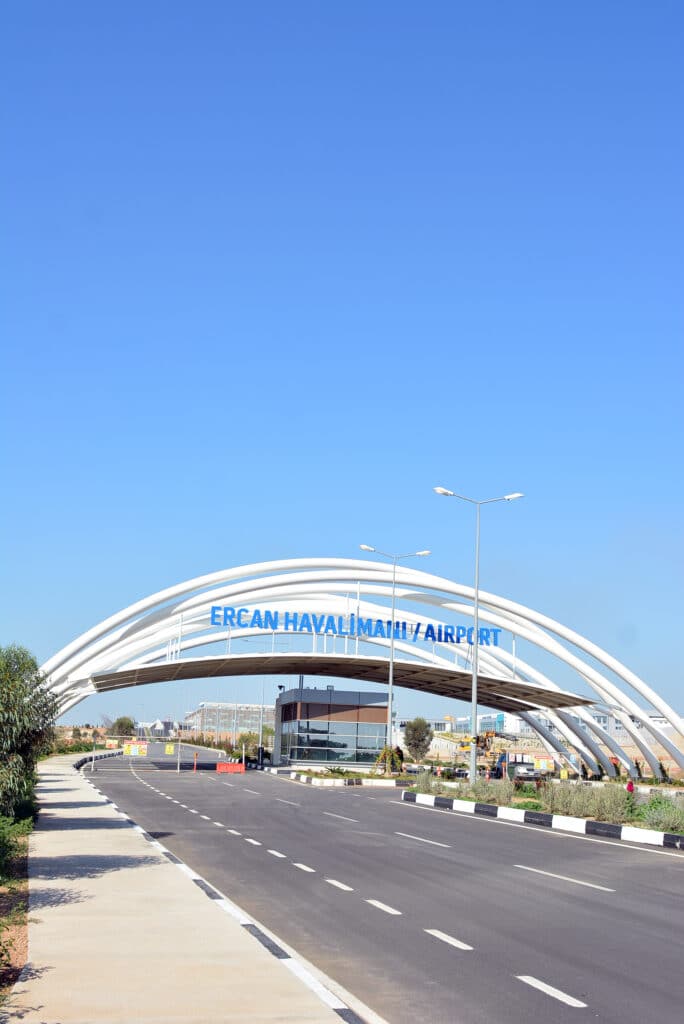
The postponement this week was caused by the absence of certain technical equipment including the transformers and the Instrumental Landing System (ILS) vital to the operations of the airport, according to Arikli.

“The airport is physically completed,” he told journalists earlier this week, speaking at a press conference at the construction site of the new Ercan/Tymbou airport. “But we have some technical devices missing. Once these devices are delivered, we will install them in a very short time and open Ercan.”

Arikli said they considered to partially open the airport on November 15, but then abandoned the idea.

“We could have opened it partially, but nobody could really accept this,” he said. “It would not be correct to partially open it after having waited for so long.”

Arikli added that Erdoğan was also against the idea of a partial opening.

The new date given for the opening is “the first months of 2023”.

The new airport will have a 10 million passenger capacity as opposed to the current four million capacity. The airport, which is directly opposite the existing Ercan/Tymbou airport, has been built on an area of 7, 800,000 square metres. The land on which it is built has been bought from its Greek Cypriot original owner through the Immovable Property Commission in the northern part of Cyprus.

The Turkish Cypriot media is also questioning why such a big airport is being built when the north only has flights to and from Turkey.

“They are heralding that the Ercan airport will open,” wrote Cenk Mutluyakalı earlier this month. “But the main question is this: Where is it opening to? They are just building a bigger airport to host ‘domestic flights’ from Turkey. So that two airlines fly to Istanbul or Ankara…”

In June, July and August 2022 some 870,000 passengers used Ercan/Tymbou.

“It is too big for the current circumstances,” confessed Arikli this week. “We don’t have the possibility to use this capacity to the maximum with just the passengers from Turkey. Such a big airport is a luxury, yes… But maybe soon we will have direct flights.”

Arikli said the most important markets in terms of flights to the northern part of Cyprus are the Central Asian and Russian markets via Turkey. He repeated the allegation that a company from a foreign country has applied for direct flights to the north.

In September, Turkish media had reported that the Russian Federation was planning to have direct flights to the northern part of Cyprus. These reports were later denied by the Russian embassy in Nicosia. The embassy told Russian state agency PIA-Novosti it “refutes any negotiations for the opening of a direct air connection”.

In October, Turkish Transportation and Infrastructure Minister Adil Karaismailoğlu had stated that Kyrgyzstan had made a request for direct flights to the northern part of Cyprus.

And according to a recent report in the private Turkish TV channel CNN Turk, talks with Pakistan and Azerbaijan regarding direct flights are continuing.

For many Turkish Cypriots however, who have heard talk of direct flights to the northern part of Cyprus for too many years now without any concrete development, these reports are hard to believe.

“This has turned into a political show,” says journalist Aysu Basri Akter. “These allegations have been going on for years. They are not newsworthy anymore.”


https://cyprus-mail.com/2022/11/13/opening-of-new-airport-in-north-delayed-yet-again/

Wednesday, 23 March 2022

Turkish Cypriot airspace? What airspace?


Esra Aygin 

Cyprus Republic’s decision to close its airspace to Russian aircraft and circulating a map showing the whole of Cyprus, has sparked a debate in the northern part of Cyprus on whether Turkish Cypriots have their own separate airspace.

The Ercan/Tymbou advisory area


Turkish Cypriot leader Ersin Tatar immediately reacted to the decision, saying Greek Cypriots cannot take decisions about the airspace in the northern part of Cyprus. “No one can encroach on our airspace,” said Tatar in a statement. 

Challenging this, President Cem Kapısız of the Turkish Cypriot Air Traffic Controllers Union asked: “If we indeed have an airspace, where does the money from the route charges go?” 

A route charge is a fee collected for each flight performed in a an airspace or route charging zone. 
 
“Where the Turkish Republic’s airspace ends, the Republic of Cyprus’ airspace begins,” Kapısız told the Cyprus Mail. “They are separated by a line. So, the route charges go to Turkey north of that line, and to the Republic of Cyprus south of that line. To say that the northern part of Cyprus has an airspace is like saying that the Turkish Republic of Northern Cyprus is a state. It is merely a claim that is not substantiated.” 
                                                                   The RoC airspace    

In practice, Turkey has allocated a portion – some 50-60 nautical miles - of its airspace to the Turkish Cypriots, according to Kapısız. “This portion is still Turkey’s airspace. We are just controlling the air traffic there,” he explained 

All the planes that fly in that portion coordinate with the air traffic controllers at Ercan/Tymbou, which is classified as an advisory airspace. 

“In this advisory airspace, we just give advisory services,” said Kapısız.  We have no authority or jurisdiction, like we would have if we had an airspace.” 

Kapısız said that the air traffic controllers at Ercan/Tymbou give service to some 700 planes daily. Only 60 of those planes land at or take off from Ercan/Tymbou. The rest are transit flights that pass over Cyprus through the portion allocated to Turkish Cypriots. This corresponds to a route charge of 8 million euros a year, which is paid to Turkey, according to the air traffic controller. 

Kapısız explained that normally, when a flight is leaving a certain airspace and entering another, the air traffic control centres in the two countries coordinate and share information. However, because the Turkish Cypriot control centre doesn’t have any coordination with the control centre in the Republic of Cyprus, pilots assume the role of the control centres and personally communicate with the air traffic controllers in Ercan/Tymbou. 

“Let’s say a plane has taken off from Larnaca. 10 minutes before entering the Ercan/Tymbou advisory airspace, the pilots voluntarily communicate with us for security reasons and give us all the necessary information,” said Kapısız. “Normally we should be getting that information from the Larnaca control center. But because we don’t coordinate, pilots assume this responsibility.”

Even though there is no coordination between the air traffic control centres in Larnaca and Ercan/Tymbou, traffic controllers still listen to each other through radio frequency to be aware of any last-minute changes regarding a flight or any urgent information. 

Normally, plans about all flight must be sent to the European Organisation for the Safety of Air Navigation (Eurocontrol) in Brussels. Besides sharing these flight plans with the relevant countries, Eurocontrol, through these flight plans, determines the route charge each country should get. To prevent the Republic of Cyprus from asking for any route charge from the Turkish aircraft using Ercan/Tymbou, Turkey simply does not send any flight plans about these to Eurocontrol, Kapısız explained.

“The flight plans are only sent to us,” said Kapısız. Eurocontrol has no information or flight plans whatsoever about the flights to Ercan/Tymbou. As far as Eurocontrol is concerned, there are no such flights. Turkey has created for us a separate world away from the real world.” 

Since Ankara does not send the flight plans of the planes using Ercan/Tymbou, it is impossible for transiting pilots to know how the air traffic over that part of Cyprus will be like, which is a serious security problem. The air traffic controllers in the Republic of Cyprus know about these flights only after they see them on the radar. On the other hand, the air traffic control centre at Ercan/Tymbou knows about all the flights in the Cypriot airspace since it gets from Ankara all the data including flights to and from Ercan/Tymbou and transiting flights. 

“This is why pilots have to coordinate with the Ercan/Tymbou air traffic control centre,” said Kapısız. “This is the customary practice and pilots experienced in the route know what to do.” 

Kapısız explained that even though Turkish Cypriots don’t have an official airspace, the air traffic control centre in Ercan/Tymbou has a very important function. 

“It is critical that in practice we control the air traffic. Otherwise, there is no way a flight from Ankara to Ercan/Tymbou and a flight from Larnaca would know about each other.” 


Friday, 11 March 2022

Lukewarm response to Greek Cypriot policy shift in north


Esra Aygin 

Although the recent confidence building measure (CBM) proposals by the Greek Cypriot leadership are being widely discussed and debated on the southern part of the island as well as the international community, they have hardly drawn the attention of Turkish Cypriots.

In a policy shift earlier this month, the Greek Cypriot leadership announced that it would be focusing on CBMs with Turkish Cypriots and Turkey, which have a much greater international backing from key players, instead of pushing for sanctions against Turkey. 

As part of the new policy, the Greek Cypriot leadership set out CBM proposals that include Turkish Cypriots handing over the fenced-off city of Varosha/Maras to the United Nations to open it to resettlement by its legal owners; transferring the operation of the Tymbou/Ercan airport to the UN to open it to international flights; and putting the customs services in the Famagusta port under EU authority to facilitate trade with the outside world. In exchange for agreeing to opening up the northern part of Cyprus to international trade and flights, the Greek Cypriot leadership wants Turkey to implement the additional Ankara protocol, by opening its ports and airports to Cyprus-flagged ships and allowing Cyprus planes to enter Turkish airspace.

“These are very important steps that would lift the isolation of Turkish Cypriots, ease their suffocation and bring them closer to both the Greek Cypriots and the world,” said International Relations expert Dr. Ipek Borman. “In the hiatus that we are in, these would render Tymbou/Ercan, Famagusta and Varosha/Maras joint living and working spaces. Discussing and concluding them would be to the benefit of the whole of Cyprus.” 

Right-wing Turkish Cypriot leader Ersin Tatar categorically rejected the opening, saying the equal sovereignty of Turkish Cypriots should first be recognised. But, except for statements of support by some Turkish Cypriot opposition parties and trade unions, there is no real discussion on the CBM proposals in the rest of the community. 

“The Turkish Cypriot community sees the peace processes indexed to big bangs,” says PRIO Senior Researcher Mete Hatay. “The peace process has been caged into the concept of ‘nothing is agreed until everything is agreed.’ When it is not a formal negotiation process aimed at a comprehensive settlement, it is not convincing.” 

According to Borman, there also are other reasons related with the desperate situation the Turkish Cypriots find themselves in. She argues that the loss of faith in a solution; the economic crisis in the northern part of Cyprus; the constant blow to Turkish Cypriots’ politics, identity and culture coming from the north; and the structural problems that have recently manifested themselves in brutal criminal incidents; do not allow for a political space for issues of bi-communal nature to be discussed. 

“There is an existential crisis in the Turkish Cypriot community,” says Borman. “People are concerned about finding work, finding food, finding a space to live. They are suffocating, and therefore, they are just holding on to palliative measures that just saves the day. There is no space to focus on the bigger picture.” 

Another important reason why the CBMs were not an issue in the northern part of Cyprus, is the Turkish Cypriots’ the lack of confidence in the government of Greek Cypriot leader Nicos Anastasiades, according to Borman, who says: “People have no confidence in Anastasiades because of everything that happened in the past and believe these proposals are aimed at just saving face. Therefore, they see it as a futile process.” 

Although the Greek Cypriot leadership has been holding discussions with international actors on the CBM proposals, these have not yet been formally presented to the Turkish Cypriot side, which may be another factor that prevented serious discussion on them. 

“Nobody really knows what exactly these proposals are,” says Turkish Cypriot journalist Sami Ozuslu. “We read about them in the Greek Cypriot media, but we don’t know any details. This makes people question them.” 

A seasoned diplomat, who took part in previous peace processes with former Turkish Cypriot leaders Mehmet Ali Talat and Mustafa Akinci, underlines we are at a turning point in the Cyprus problem and these CBMs have the potential to change Turkey’s attitude and make “damage control.” 

“We are losing Varosha/Maras, Ercan/Tymbou is becoming a domestic airport of Turkey. We are rapidly moving towards permanent partition,” said the diplomat. “This is why it is very important that these proposals are prepared, tabled and discussed seriously… Turkey will either benefit from these CBMs and enter the election period in 2023 with a European perspective – and therefore not do anything crazy in Cyprus- or these CBMs will fail and Turkey will enter the election period with further crazy steps in Cyprus.”